
Technical Support & Resources
Visit our FAQ
Contact Us
Toll Free Phone (USA and Canada Only): (888) 526-5351
Direct Phone: (734) 975-3888
Product Categories
Product Type
Application
GDP-L-Fucose Synthase (human, recombinant)
Item No. 26695
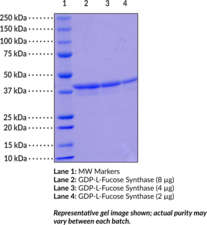
Technical Information
- GDP-4-keto-6-deoxy-D-Mannose-3,5-Epimerase-4-Reductase
- Protein FX
- Red Cell NADP(H)-Binding Protein
- Short-Chain Dehydrogenase/Reductase Family 4E Member 1
- Tissue Specific Transplantation Antigen P35B
- TSTA3
Shipping & Storage Information
Recommended Products
Certificates of Analysis & Batch Specific Data
Provide batch numbers separated by commas to download or request available product inserts, QC sheets, certificates of analysis, data packs, and GC-MS data.

Visit Our Cancer Resource Center
Find Tools & Resources to Study the Hallmarks of Cancer
- Cancer cell signaling & regulation
- Cancer metabolism
- Tumor microenvironment
Product Description
GDP-L-Fucose synthase, encoded by the gene TSTA3, is an NADP(H)-binding protein that catalyzes the final step in the synthesis of GDP-L-fucose from GDP-D-mannose.1,2 It converts GDP-4-keto-6-deoxy-D-mannose to GDP-L-fucose via a two-step reaction consisting of epimerization followed by NADPH-dependent reduction. GDP-L-Fucose synthase exists as a homodimer and is comprised of an N-terminal NADPH-binding domain and a C-terminal substrate-binding domain. TSTA3-/- mice exhibit increases in colonic inflammation, dysplasia, and epithelial permeability, which are reversed following addition of fucose to the diet.3 These mice also exhibit alterations in gut microflora and increased bacterial burden in colon transluminal tissue and feces when fed a normal diet versus a fucose-supplemented diet, and the colonic effects of TSTA3 deletion can be reversed following administration of antibiotics. GDP-L-Fucose synthase has been identified as an autoantigen that can be recognized by CD4+ T cells derived from patients with multiple sclerosis.4 Expression of GDP-L-fucose synthase in primary tumor tissue samples from patients with esophageal squamous cell carcinoma (ESCC) positively correlates with increased clinical stage, lymph node metastasis, and poor prognosis.5
WARNING This product is not for human or veterinary use.
References & Product Citations
1. Synthesis of GDP-
2. The crystal structure of human GDP-
3. Fucosylation deficiency in mice leads to colitis and adenocarcinoma. Gastroenterology 152(1), 193-205 (2017).
4. GDP-
5. High TSTA3 expression as a candidate biomarker for poor prognosis of patients with ESCC. Technol. Cancer Res. Treat. 17, 1533033818781405 (2018).
Contact Info
Cayman Chemical1180 East Ellsworth RoadAnn Arbor, Michigan 48108 USAToll Free: (800) 364-9897(USA and Canada only)Fax: (734) 971-3640


