
Technical Support & Resources
Visit our FAQ
Contact Us
Toll Free Phone (USA and Canada Only): (888) 526-5351
Direct Phone: (734) 975-3888
Product Categories

Technical Information
- Glutathione Peroxidase 4
- PHGPx
- Phospholipid Hydroperoxide Glutathione Peroxidase
Shipping & Storage Information
Recommended Products
Certificates of Analysis & Batch Specific Data
Provide batch numbers separated by commas to download or request available product inserts, QC sheets, certificates of analysis, data packs, and GC-MS data.
Product Description
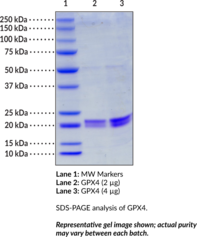
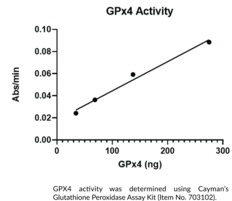
Glutathione peroxidase 4 (GPX4) is a selenocysteine-containing glutathione peroxidase that is encoded by the GPX4 gene in humans and protects cellular membranes from oxidative damage.1,2 It is a monomeric protein consisting of a thioredoxin motif and a selenocysteine-glutamine-tryptophan catalytic triad that reduces lipid hydroperoxides, including phospholipid, polyunsaturated lipid, and sterol hydroperoxides, to non-toxic lipid alcohols. During this process, the active site selenocysteine becomes oxidized and must subsequently be replenished by the reducing substrate glutathione (GSH).2 There are three isoforms of GPX4, mitochondrial mGPX4, cytosolic cGPX4, and nuclear nGPX4/snGPX4, that are expressed in all tissue types in rats, with the highest mRNA levels observed in testes.1,2,3 GPX4 is a key regulator of ferroptosis that inhibits ferroptotic cell death by preventing iron-dependent accumulation of toxic lipid reactive oxygen species.2 Mutations in GPX4 have been found in patients with Sedaghatian-type spondylometaphyseal dysplasia (SSMD), and silencing of Gpx4 in mice is embryonic lethal.4,2 Cayman's GPX4 (human, recombinant; His-tagged) protein has a selenocysteine incorporated in the active site that has been confirmed by mass spectrometry. It can be used for Western blot, ELISA, and enzymatic assays.
WARNING This product is not for human or veterinary use.
References & Product Citations
1. Biological significance of phospholipid hydroperoxide glutathione peroxidase (PHGPx, GPx4) in mammalian cells. Free Radic. Biol. Med. 34(2), 145-169 (2003).
2. GPX4 at the crossroads of lipid homeostasis and ferroptosis. Proteomics 19(18), e1800311 (2019).
3. Distinct promoters determine alternative transcription of gpx-
4. Mutations in the enzyme glutathione peroxidase 4 cause Sedaghatian-
Copper-
Contact Info
Cayman Chemical1180 East Ellsworth RoadAnn Arbor, Michigan 48108 USAToll Free: (800) 364-9897(USA and Canada only)Fax: (734) 971-3640


