
Technical Support & Resources
Information provided in the product description is from published literature. Due to the nature of scientific experimentation, your results (e.g., selectivity and effective concentrations) or specific application for this product may differ. If you have questions about how this product fits your application, please contact our technical support staff.
Visit our FAQ
Contact Us
Toll Free Phone (USA and Canada Only): (888) 526-5351
Direct Phone: (734) 975-3888
Product Categories
Research Area

Technical Information
Shipping & Storage Information
Recommended Products
Certificates of Analysis & Batch Specific Data
Provide batch numbers separated by commas to download or request available product inserts, QC sheets, certificates of analysis, data packs, and GC-MS data.
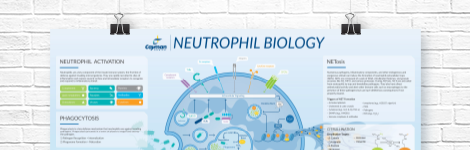
Neutrophil Biology Wall Poster
Explore how neutrophils shape the immune response in health and disease. This poster highlights neutrophil pathogen defense mechanisms, including phagocytosis, degranulation, and NETosis, as well as neutrophil roles in inflammation and NET-associated pathologies.
DOWNLOAD NOWProduct Description
AA147 is an endoplasmic reticulum (ER) proteostasis regulator.1,2,3 It activates an activating transcription factor 6-dependent (ATF6-dependent) ER stress response element reporter and antioxidant response element reporter in HT22 hippocampal cells (EC50s = 3.6 and 3.92 µM, respectively) and protects against glutamate-induced cytotoxicity and prevents increases in reactive oxygen species (ROS) in HT22 cells when used at a concentration of 10 µM.1 AA147 (10 µM) reduces cell death induced by the unfolded protein response (UPR) activator tunicamycin and increases ER-associated protein degradation (ERAD) in neonatal rat ventricular myocytes.2 It reduces the myocardial, renal, and cerebral infarct size as a percentage of the area at risk in mouse models of ischemia-reperfusion injury induced by left anterior descending coronary artery (LAD) ligation, renal portal system occlusion, or middle cerebral artery occlusion (MCAO), respectively, when administered at a dose of 2 mg/kg. AA147 also prevents the production of non-structural protein 5 (NS5) in dengue virus-infected Huh7 cells (IC50 = ~1 µM).3
WARNING This product is not for human or veterinary use.
References & Product Citations
1. Metabolically activated proteostasis regulators protect against glutamate toxicity by activating NRF2. ACS Chem. Biol. 16(12), 2852-2863 (2021).
2. Pharmacologic ATF6 activation confers global protection in widespread disease models by reprograming cellular proteostasis. Nat. Commun. 10(1), 187 (2019).
3. Small-
Contact Info
Cayman Chemical1180 East Ellsworth RoadAnn Arbor, Michigan 48108 USAToll Free: (800) 364-9897(USA and Canada only)Fax: (734) 971-3640


