
Technical Support & Resources
Visit our FAQ
Contact Us
Toll Free Phone (USA and Canada Only): (888) 526-5351
Direct Phone: (734) 975-3888
Product Categories
HIF-1α (C-Term) Monoclonal Antibody (Clone 8B12)
Item No. 27227
Technical Information
- ARNT-interacting protein
- Hypoxia-Inducible Factor-1α
Shipping & Storage Information
Recommended Products


Certificates of Analysis & Batch Specific Data
Provide batch numbers separated by commas to download or request available product inserts, QC sheets, certificates of analysis, data packs, and GC-MS data.

Visit Our Cancer Resource Center
Find Tools & Resources to Study the Hallmarks of Cancer
- Cancer cell signaling & regulation
- Cancer metabolism
- Tumor microenvironment
Product Description
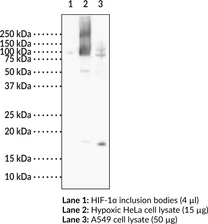
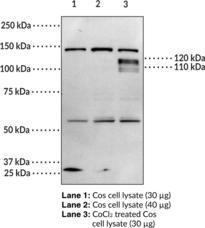
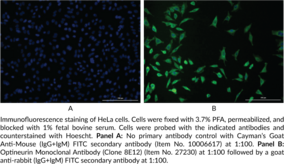
Hypoxia-inducible factor-1α (HIF-1α) is a transcription factor subunit that belongs to the basic helix-loop-helix PER-ARNT-SIM (bHLH-PAS) protein family.1,2 It contains bHLH and PAS domains that mediate DNA binding and heterodimerization with the HIF-1β subunit, an oxygen-dependent degradation (ODD) domain that is hydroxylated by prolyl hydroxylase in the presence of oxygen to target HIF-1α for proteasomal degradation, and N- and C-terminal transactivation domains responsible for regulating the expression of HIF-1 target genes.2,3 Under hypoxic conditions, HIF-1α is stabilized, accumulates in the cytoplasm, and is translocated to the nucleus where it forms a heterodimer with HIF-1β and induces the expression of genes involved in maintaining cellular oxygen homeostasis.2,4,1,5 It is also involved in angiogenesis, glucose utilization, and pH regulation under hypoxic conditions, including in the tumor microenvironment.6 HIF-1α is overexpressed in a variety of cancer cell lines where it promotes survival of cancer cells and increases invasiveness under hypoxic conditions and, in vivo, overexpression is associated with aggressiveness and progression of various cancers and poor disease-free survival.7,8,6,9 Homozygous knockout of HIF-1α is embryonic lethal due to disruptions in vascular development but conditional knockout models have demonstrated a role for HIF-1α in inflammation, immunity, and osteogenesis.6 Cayman’s HIF-1α Monoclonal Antibody can be used for Western blot and immunocytochemistry applications. The antibody recognizes HIF-1α at 93 kDa from human and mouse samples.
WARNING This product is not for human or veterinary use.
References & Product Citations
1. Hypoxia-
2. Hypoxia-
3. Advances in inhibition of protein-
4. Cellular adaptation to hypoxia: O2-
5. HIF hydroxylation and the mammalian oxygen-
6. Biology of HIF-
7. The expression and distribution of the hypoxia-
8. Overexpression of MMP-
9. HIF-
Contact Info
Cayman Chemical1180 East Ellsworth RoadAnn Arbor, Michigan 48108 USAToll Free: (800) 364-9897(USA and Canada only)Fax: (734) 971-3640


