
Technical Support & Resources
Visit our FAQ
Contact Us
Toll Free Phone (USA and Canada Only): (888) 526-5351
Direct Phone: (734) 975-3888
Product Categories
Optineurin (C-Term) Monoclonal Antibody (Clone 8E12)
Item No. 27230
Technical Information
- E3-14.7K-Interacting Protein
- FIP-2
- GLC1E
- HIP7
- Huntingtin-Interacting Protein L
- Huntingtin-Interacting Protein 7
- Huntingtin Yeast Partner L
- HYPL
- IP7
- NRP
- OPTN
Shipping & Storage Information
Recommended Products
Certificates of Analysis & Batch Specific Data
Provide batch numbers separated by commas to download or request available product inserts, QC sheets, certificates of analysis, data packs, and GC-MS data.

Neutrophil Biology Wall Poster
Explore how neutrophils shape the immune response in health and disease. This poster highlights neutrophil pathogen defense mechanisms, including phagocytosis, degranulation, and NETosis, as well as neutrophil roles in inflammation and NET-associated pathologies.
DOWNLOAD NOWProduct Description
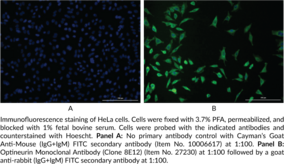
Optineurin (OPTN) is an adapter protein with roles in autophagy, vesicular trafficking, and inflammatory responses to viral and bacterial pathogens.1 OPTN binds to ubiquitinated cargo via its ubiquitin-binding domain and targets them for autophagic degradation by recruiting LC3-expressing phagophore membranes via its LC3-interacting region. It is phosphorylated by TANK binding kinase 1 (TBK1), which increases the binding affinity of OPTN for polyubiquitinated mitochondria, promotes TBK1 activation and recruitment to the mitochondria, and permits the degradation of damaged mitochondria via PINK1/parkin-dependent mitophagy.2 OPTN regulates transferrin receptor trafficking and recycling by mediating the association between the membrane trafficking protein Rab8 and its activator TBC1D17.3 Mutation of the OPTN ubiquitin binding domain reduces LPS- and poly(I:C)-induced increases in IFN-β levels in bone marrow-derived macrophages (BMDMs).4 OPTN knockout increases mortality and reduces plasma levels of TNF-α and IL-6 in a mouse model of E. coli-induced peritonitis.5 Mutations in OPTN are associated with primary open angle glaucoma, amyotrophic lateral sclerosis (ALS), Paget's disease, and Alzheimer's disease.1,6 Cayman's Optineurin Monoclonal Antibody (Clone 8E12) can be used for immunocytochemistry applications.
WARNING This product is not for human or veterinary use.
References & Product Citations
1. Cellular functions of optineurin in health and disease. Trends Immunol. 37(9), 621-633 (2016).
2. The TBK1-
3. Functional analysis of optineurin and some of its disease-
4. Polyubiquitin binding to optineurin is required for optimal activation of TANK-
5. Optineurin deficiency in mice contributes to impaired cytokine secretion and neutrophil recruitment in bacteria-
6. Dysfunction of optineurin in amyotrophic lateral sclerosis and glaucoma. Front. Immunol. 9, 1017 (2018).
Contact Info
Cayman Chemical1180 East Ellsworth RoadAnn Arbor, Michigan 48108 USAToll Free: (800) 364-9897(USA and Canada only)Fax: (734) 971-3640


