
Technical Support & Resources
Visit our FAQ
Contact Us
Toll Free Phone (USA and Canada Only): (888) 526-5351
Direct Phone: (734) 975-3888
Product Categories
Product Type
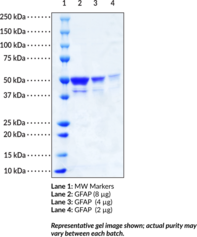
Technical Information
- ALXDRD
- Glial Fibrillary Acidic Protein, Intermediate Filament Protein
Shipping & Storage Information
Recommended Products
Certificates of Analysis & Batch Specific Data
Provide batch numbers separated by commas to download or request available product inserts, QC sheets, certificates of analysis, data packs, and GC-MS data.
Product Description
Glial fibrillary acidic protein (GFAP) is a protein encoded by the GFAP gene in humans and a member of the class III intermediate filament (IF) protein family.1 It is composed of an N-terminal head domain, a highly conserved α-helical rod domain, and a C-terminal tail domain that mediate GFAP self-assembly, dimerization, and oligomerization, respectively.2,3 GFAP is expressed in, and has commonly been used as a pan marker for, mature astrocytes.1 GFAP IFs form a dynamic network of cytosolic filament proteins that collectively provide structure and strength to the cytoskeleton of astrocytes, thus supporting their morphology and function.1 Isolated astrocytes from neonatal Gfap-/- mouse brain have reduced numbers of IFs and IF bundles, increased proliferation, and loss of contact-inhibited growth.4,5 Gfap-/- mice develop more diffuse and infiltrative brain lesions compared to wild-type littermates in a mouse model of experimental autoimmune encephalomyelitis (EAE).6 Mutations in the rod and tail domains of GFAP have been associated with Rosenthal fiber formation, a hallmark of Alexander disease.7 Transgenic overexpression of Gfap in mice increases the expression of certain cytokines and antioxidative enzymes in the olfactory bulb and has been used as a mouse model of Alexander disease.8 GFAP can be citrullinated on the arginine residue at position 270 (R270) and at R416 by protein arginine deiminase 1 (PAD1; Item No. 10784) and PAD2 (Item No. 10785).9 Citrullinated GFAP has been found in rat cerebral cortex in a model of traumatic brain injury, as well as in postmortem hippocampus from patients with Alzheimer's disease.9,10
WARNING This product is not for human or veterinary use.
References & Product Citations
1. Type III intermediate filaments desmin, glial fibrillary acidic protein (GFAP), vimentin, and peripherin. Cold Spring Harb. Perspect. Biol. 9(12), a021642 (2017).
2. Glial fibrillary acidic protein: Dynamic property and regulation by phosphorylation. Brain Pathol. 4(3), 239-243 (1994).
3. The endless story of the glial fibrillary acidic protein. J. Cell Sci. 107(Pt 8), 2299-2311 (1994).
4. GFAP-
5. Transfection of human astrocytoma cells with glial fibrillary acidic protein complementary DNA: Analysis of expression, proliferation, and tumorigenicity. Cancer Res. 53(15), 3624-3631 (1993).
6. Experimental autoimmune encephalomyelitis in mice lacking glial fibrillary acidic protein is characterized by a more severe clinical course and an infiltrative central nervous system lesion. Am. J. Pathol. 152(1), 251-259 (1998).
7. GFAP mutations in Alexander disease. Int. J. Dev. Neurosci. 20(3-5), 259-268 (2002).
8. Gene expression analysis in mice with elevated glial fibrillary acidic protein and Rosenthal fibers reveals a stress response followed by glial activation and neuronal dysfunction. Hum. Mol. Genet. 14(16), 2443-2458 (2005).
9. Mass spectrometric identification of citrullination sites and immunohistochemical detection of citrullinated glial fibrillary acidic protein in Alzheimer’s disease brains. J. Neurosci. Res. 93(11), 1664-1674 (2015).
10. Protein citrullination: A proposed mechanism for pathology in traumatic brain injury. Front. Neurol. 6:204, (2015).
Contact Info
Cayman Chemical1180 East Ellsworth RoadAnn Arbor, Michigan 48108 USAToll Free: (800) 364-9897(USA and Canada only)Fax: (734) 971-3640


