
Technical Support & Resources
Visit our FAQ
Contact Us
Toll Free Phone (USA and Canada Only): (888) 526-5351
Direct Phone: (734) 975-3888
Product Categories
Product Type
Anthrax Edema Factor (EF) (recombinant from Bacillus anthracis)
Item No. 28210
Technical Information
Shipping & Storage Information
Recommended Products
Certificates of Analysis & Batch Specific Data
Provide batch numbers separated by commas to download or request available product inserts, QC sheets, certificates of analysis, data packs, and GC-MS data.
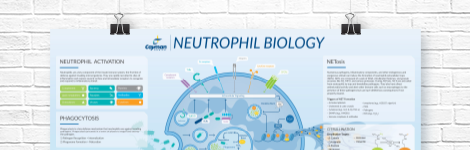
Neutrophil Biology Wall Poster
Explore how neutrophils shape the immune response in health and disease. This poster highlights neutrophil pathogen defense mechanisms, including phagocytosis, degranulation, and NETosis, as well as neutrophil roles in inflammation and NET-associated pathologies.
DOWNLOAD NOWProduct Description
Anthrax edema factor (EF) is a component of edema toxin (EdTx) produced by B. anthracis.1,2 It is comprised of an N-terminal protective antigen (PA) binding domain (PABD), an adenylyl cyclase domain, and a helical domain.2 Inactive EF binds oligomerized B. anthracis PA on the host cell surface. EF and PA, together known as EdTx, are endocytosed by the host cell, after which PA facilitates translocation of EF into the host cell cytoplasm. There, calmodulin binds the EF helical domain and activates its adenylyl cyclase activity, leading to an increase in intracellular cAMP.
WARNING This product is not for human or veterinary use.
References & Product Citations
1. Anthrax lethal and edema toxins in anthrax pathogenesis. Trends Microbiol. 22(6), 317-325 (2014).
2. The adenylyl cyclase activity of anthrax edema factor. Mol. Aspects Med. 30(6), 423-430 (2009).
Contact Info
Cayman Chemical1180 East Ellsworth RoadAnn Arbor, Michigan 48108 USAToll Free: (800) 364-9897(USA and Canada only)Fax: (734) 971-3640


