
Technical Support & Resources
Visit our FAQ
Contact Us
Toll Free Phone (USA and Canada Only): (888) 526-5351
Direct Phone: (734) 975-3888
Product Categories
Product Type
Application
Technical Information
- B7-DC
- CD273
- PDCD1 Ligand 2
- Programmed Cell Death 1 Ligand 2
Shipping & Storage Information
Recommended Products
Certificates of Analysis & Batch Specific Data
Provide batch numbers separated by commas to download or request available product inserts, QC sheets, certificates of analysis, data packs, and GC-MS data.

Visit Our Cancer Resource Center
Find Tools & Resources to Study the Hallmarks of Cancer
- Cancer cell signaling & regulation
- Cancer metabolism
- Tumor microenvironment
Product Description
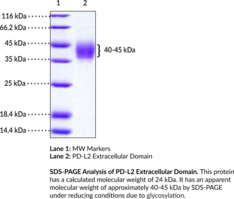
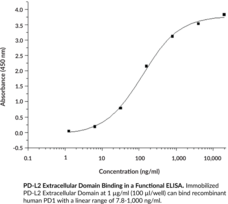
Programmed cell death 1 ligand 2 (PD-L2), also known as B7-DC and CD273, is a B7 family protein that is involved in regulation and attenuation of the adaptive immune response.1,2 It is a 273-amino acid type I transmembrane protein encoded by the PDCD1LG2 gene in humans and is comprised of a 221-amino acid extracellular domain consisting of a signal peptide, an IgV-like domain, and an IgC-like domain, a transmembrane domain, and a cytoplasmic domain.3,4 PD-L2 is expressed in dendritic cells and macrophages and is induced by IL-4 and IFN-γ.1 Binding of PD-L2 to its receptor, programmed cell death protein 1 (PD-1), suppresses T cell proliferation and cytokine production.2 PD-L2 is also expressed in a variety of tumor types, and elevated expression of PD-L2 in tumor tissue is associated with decreased overall survival in patients with hepatocellular carcinoma.5,6 Cayman's PD-L2 Extracellular Domain (human, recombinant) protein can be used for ELISA and binding assay applications. This protein consists of 211 amino acids, has a calculated molecular weight of 24 kDa, an a predicted N-terminus of Leu20 after signal peptide cleavage. By SDS-PAGE, under reducing conditions, the apparent molecular mass of the protein is 40 to 45 kDa due to glycosylation.
WARNING This product is not for human or veterinary use.
References & Product Citations
1. PD-
2. PD-
3. The Pekin duck programmed death ligand-
4. PD-
5. PD-
6. Overexpression of PD-
Contact Info
Cayman Chemical1180 East Ellsworth RoadAnn Arbor, Michigan 48108 USAToll Free: (800) 364-9897(USA and Canada only)Fax: (734) 971-3640


