
Technical Support & Resources
Visit our FAQ
Contact Us
Toll Free Phone (USA and Canada Only): (888) 526-5351
Direct Phone: (734) 975-3888
Product Categories
Application

Technical Information
Shipping & Storage Information
Recommended Products
Certificates of Analysis & Batch Specific Data
Provide batch numbers separated by commas to download or request available product inserts, QC sheets, certificates of analysis, data packs, and GC-MS data.
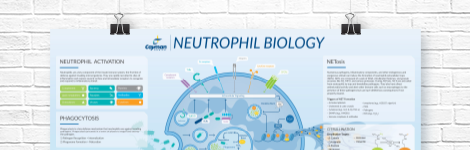
Neutrophil Biology Wall Poster
Explore how neutrophils shape the immune response in health and disease. This poster highlights neutrophil pathogen defense mechanisms, including phagocytosis, degranulation, and NETosis, as well as neutrophil roles in inflammation and NET-associated pathologies.
DOWNLOAD NOWProduct Description
Atovaquone-d4 is intended for use as an internal standard for the quantification of atovaquone (Item No. 23802) by GC- or LC-MS. Atovaquone is a broad-spectrum antiprotozoal agent that is active against Plasmodium, Toxoplasma, and Babesia, among other protozoa.1 It inhibits complex III activity on dihydroorotate in isolated P. falciparum and P. yoelii mitochondria more potently than in rat liver mitochondria (EC50s = 0.95, 0.94, and 510 nM, respectively) and depolarizes the mitochondrial membrane in P. yoelii-infected mouse erythrocytes (EC50 = 260 nM).2,3 Atovaquone also inhibits transport mediated by human breast cancer resistance protein (BCRP) and P-glycoprotein in membrane vesicles (IC50s = 0.23 and 6.8 μM, respectively).4 It inhibits the growth of T. gondii in MRC-5 human lung fibroblasts in vitro (IC50 = ~64 nM) and increases mean survival of T. gondii-infected mice from 5.5 to 21.2 days when administered at a dose of 100 mg/kg per day.5 Formulations containing atovaquone have been used in the treatment of Pneumocystis pneumonia and toxoplasmosis as well as in combination with proguanil in the treatment of malaria and babesiosis.
WARNING This product is not for human or veterinary use.
References & Product Citations
1. Molecular basis for atovaquone binding to the cytochrome bc1 complex. The Journal of Biological Chemisty 278(33), 31312-31318 (2003).
2. Site of action of the antimalarial hydroxynaphthoquinone, 2-
3. Atovaquone, a broad spectrum antiparasitic drug, collapses mitochondrial membrane potential in a malarial parasite. The Journal of Biological Chemisty 272(7), 3961-3966 (1997).
4. Atovaquone and quinine anti-
5. In vitro and in vivo activities of the hydroxynaphthoquinone atovaquone alone or combined with pyrimethamine, sulfadiazine, clarithromycin, or minocycline against Toxoplasma gondii. Antimicrob. Agents Chemother. 37(11), 2371-2378 (1993).
Contact Info
Cayman Chemical1180 East Ellsworth RoadAnn Arbor, Michigan 48108 USAToll Free: (800) 364-9897(USA and Canada only)Fax: (734) 971-3640


