
Technical Support & Resources
Visit our FAQ
Contact Us
Toll Free Phone (USA and Canada Only): (888) 526-5351
Direct Phone: (734) 975-3888
Product Categories
Application

Technical Information
Shipping & Storage Information
Recommended Products
Certificates of Analysis & Batch Specific Data
Provide batch numbers separated by commas to download or request available product inserts, QC sheets, certificates of analysis, data packs, and GC-MS data.
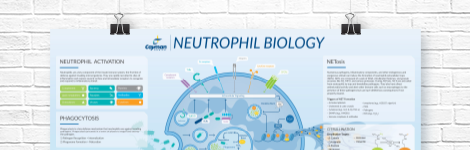
Neutrophil Biology Wall Poster
Explore how neutrophils shape the immune response in health and disease. This poster highlights neutrophil pathogen defense mechanisms, including phagocytosis, degranulation, and NETosis, as well as neutrophil roles in inflammation and NET-associated pathologies.
DOWNLOAD NOWProduct Description
Doxycycline-d3 is intended for use as an internal standard for the quantification of doxycycline (Item No. 14422) by GC- or LC-MS. Doxycycline is a broad-spectrum tetracycline antibiotic.1,2 It inhibits bacterial protein synthesis by binding to ribosomes.2,3 Doxycycline also selectively inhibits human matrix metalloproteinase-8 (MMP-8) and MMP-13 over MMP-1 with 50, 60, and 5% inhibition, respectively, when used at a concentration of 30 μM.4 It can be used as a regulator for inducible gene expression systems where expression depends on either the presence (Tet-On) or absence (Tet-Off) of doxycycline.5,6 Formulations containing doxycycline have been used in the treatment of bacterial infections and the prevention of malaria.
WARNING This product is not for human or veterinary use.
References & Product Citations
1. The in vitro activity of vibramycin (doxycycline). Chemotherapia (Basel) 13(Suppl. 1), 1-6 (1968).
2. Tetracycline compounds with non-
3. Tetracycline analogs whose primary target is not the bacterial ribosome. Antimicrob. Agents Chemother. 38(4), 637-640 (1994).
4. Specificity of inhibition of matrix metalloproteinase activity by doxycycline: Relationship to structure of the enzyme. Arthritis Rheum. 42(6), 1140-1146 (1999).
5. A novel doxycycline inducible autoregulatory plasmid which displays “on”/“off” regulation suited to gene therapy applications. Gene Ther. 7(24), 2061-2070 (2000).
6. Simple piggyBac transposon-
Contact Info
Cayman Chemical1180 East Ellsworth RoadAnn Arbor, Michigan 48108 USAToll Free: (800) 364-9897(USA and Canada only)Fax: (734) 971-3640


