
Technical Support & Resources
Information provided in the product description is from published literature. Due to the nature of scientific experimentation, your results (e.g., selectivity and effective concentrations) or specific application for this product may differ. If you have questions about how this product fits your application, please contact our technical support staff.
Visit our FAQ
Contact Us
Toll Free Phone (USA and Canada Only): (888) 526-5351
Direct Phone: (734) 975-3888
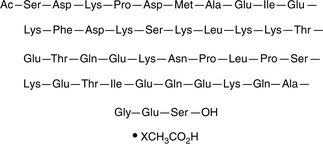
Thymosin β4 (human, mouse, rat, porcine, bovine) (acetate)
Item No. 28605
Technical Information
- Ac-SDKPDMAEIEKFDKSKLKKTETQEKNPLPSKETIEQEKQAGES
Shipping & Storage Information
Recommended Products





Certificates of Analysis & Batch Specific Data
Provide batch numbers separated by commas to download or request available product inserts, QC sheets, certificates of analysis, data packs, and GC-MS data.
Neutrophil Biology Wall Poster
Explore how neutrophils shape the immune response in health and disease. This poster highlights neutrophil pathogen defense mechanisms, including phagocytosis, degranulation, and NETosis, as well as neutrophil roles in inflammation and NET-associated pathologies.
DOWNLOAD NOWProduct Description
Thymosin β4 is an actin-sequestering peptide that has wound healing and anti-inflammatory activities.1,2,3 It regulates cytoskeletal rearrangement by binding to actin (Kds = 0.7 and 2.1 µM for human platelets and rabbit muscle, respectively) and inhibiting the polymerization of actin monomers.1 Thymosin β4 increases in vitro migration of human umbilical vein endothelial cells (HUVECs), keratinocytes, and coronary artery endothelial cells, but not fibroblasts, actin smooth muscle cells, neutrophils, monocytes, or HT-1080 fibrosarcoma cells, when used at concentrations ranging from 0.001 to 1 µg/ml.2,4 It increases gap closure and reduces wound width in a rat full-thickness cutaneous wound model when administered at a dose of 60 µg.2 Thymosin β4 (1 µg/ml) inhibits TNF-α-induced NF-ĸB phosphorylation and nuclear translocation in immortalized human corneal epithelial cells and decreases the expression of chemokine (C-X-C motif) ligand 1 (CXCL1), CXCL2, matrix metalloproteinase-9 (MMP-9), and MMP-2 in the cornea in a mouse model of sodium hydroxide-induced corneal injury when administered at a dose of 5 µg.3
WARNING This product is not for human or veterinary use.
References & Product Citations
1. Interaction of thymosin β4 with muscle and platelet actin: Implications for actin sequestration in resting platelets. Biochemistry 31(27), 6179-6185 (1992).
2. Thymosin β4 accelerates wound healing. J. Invest. Dermatol. 113(3), 364-368 (1999).
3. Thymosin beta 4 suppression of corneal NFκB: A potential anti-
4. Thymosin β4 stimulates directional migration of human umbilical vein endothelial cells. The FASEB Journal 11(6), 474-481 (1997).
Contact Info
Cayman Chemical1180 East Ellsworth RoadAnn Arbor, Michigan 48108 USAToll Free: (800) 364-9897(USA and Canada only)Fax: (734) 971-3640


