
Technical Support & Resources
Visit our FAQ
Contact Us
Toll Free Phone (USA and Canada Only): (888) 526-5351
Direct Phone: (734) 975-3888
Product Categories
APP (C99 Fragment) Monoclonal Antibody (Clone 8G4)
Item No. 28636
Technical Information
- ABPP
- Alzheimer's Disease Amyloid Protein
- Amyloid-β A4 Protein
- Amyloid Precursor Protein
- APPI
- Cerebral Vascular Amyloid Peptide
- β C-terminal Fragment
- βCTF
- CVAP
- PN-II
- PreA4
- Protease Nexin-II
Shipping & Storage Information
Recommended Products
Certificates of Analysis & Batch Specific Data
Provide batch numbers separated by commas to download or request available product inserts, QC sheets, certificates of analysis, data packs, and GC-MS data.
Product Description
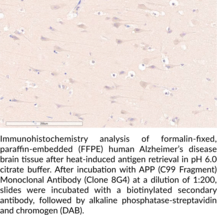
Amyloid precursor protein (APP) is a type I transmembrane protein that has a central role in the pathogenesis of Alzheimer’s disease, as well as additional roles in brain development, neuronal plasticity, and memory.1 APP is cleaved by β-secretase (BACE) in neuronal endosomes during amyloidogenic processing of APP, generating the C-terminal C99 fragment, which is localized to the endoplasmic membrane.2,3 C99 is further cleaved by γ-secretase, liberating the APP intracellular domain (AICD) and generating amyloid-β (Aβ) peptides of various lengths, including Aβ40 (Item No. 21617) and Aβ42 (Item No. 20574), which are hallmarks of Alzheimer's disease. APP can also be cleaved by α-secretase during non-amyloidogenic processing of APP, which occurs at the neuronal plasma membrane and generates the neuroprotective soluble APP fragment sAPPα, as well as a variety of other fragments, including the C47 fragment.1,4 Transgenic mice expressing mutant forms of APP exhibit extracellular Aβ deposits in the brain, as well as cognitive dysfunction, and are widely used models of Alzheimer’s disease.5 Intraneuronal C99 levels are increased in the transgenic APPE693Q mouse model of Alzheimer’s disease, as well as postmortem frontal cortex from patients with sporadic Alzheimer's disease.3,6 Cayman's APP (C99 Fragment) Monoclonal Antibody (Clone 8G4) can be used for ELISA and immunohistochemistry (IHC) applications. The antibody recognizes the C-terminal region corresponding to the C99 fragment to detect intact APP, as well as the C47 APP fragment.
WARNING This product is not for human or veterinary use.
References & Product Citations
1. Not just amyloid: Physiological functions of the amyloid precursor protein family. Nat. Rev. Neurosci. 18(5), 281-298 (2017).
2. Targeting amyloidogenic processing of APP in Alzheimer’s disease. Front. Mol. Neurosci. 13, 137 (2020).
3. Does intraneuronal accumulation of carboxyl-
4. Insertion of lysosomal targeting sequences to the amyloid precursor protein reduces secretion of βA4. J. Neurochem. 68(4), 1571-1580 (1997).
5. APP mouse models for Alzheimer’s disease preclinical studies. EMBO J. 36(17), 2473-2487 (2017).
6. C99 selectively accumulates in vulnerable neurons in Alzheimer’s disease. Alzheimers Dement. 16(2), 273-282 (2020).
Contact Info
Cayman Chemical1180 East Ellsworth RoadAnn Arbor, Michigan 48108 USAToll Free: (800) 364-9897(USA and Canada only)Fax: (734) 971-3640


