
Technical Support & Resources
Visit our FAQ
Contact Us
Toll Free Phone (USA and Canada Only): (888) 526-5351
Direct Phone: (734) 975-3888
Product Categories
Technical Information
- Glycosylation-inhibiting Factor
- Macrophage Migration Inhibitory Factor
Shipping & Storage Information
Recommended Products
Certificates of Analysis & Batch Specific Data
Provide batch numbers separated by commas to download or request available product inserts, QC sheets, certificates of analysis, data packs, and GC-MS data.

Visit Our Cancer Resource Center
Find Tools & Resources to Study the Hallmarks of Cancer
- Cancer cell signaling & regulation
- Cancer metabolism
- Tumor microenvironment
Product Description
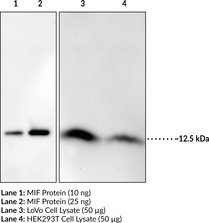
Macrophage migration inhibitory factor (MIF) is a pro-inflammatory cytokine encoded by the MIF gene.1 It is released from white blood cells upon stimulation by bacterial antigens or glucocorticoids and from the anterior pituitary in response to trauma. MIF binds to CD74 receptors on macrophages, lymphocytes, dendritic, and endothelial cells and stimulates expression and secretion of the pro-inflammatory cytokines TNF-α, IFN-γ, IL-1β, IL-6, and IL-8, as well as COX-2, chemokine (C-C motif) ligand 2 (CCL2), and nitric oxide. MIF knockdown is protective against LPS-induced shock and MIF pro-inflammatory signaling is positively correlated with arthritis, colitis, and systemic inflammatory response syndrome (SIRS), which is associated with cardiovascular surgery, sepsis, and injury-mediated multiple organ dysfunction syndrome (MODS).1,2 MIF is overexpressed in a variety of human cancers, including pancreatic, prostate, breast, colon, brain, lung, and skin, and has been shown to promote hypoxia-induced HIF-1α stabilization leading to changes in the tumor microenvironment and stimulation of angiogenesis and neovascularization.3 MIF is also an enzymatically active keto-enol tautomerase that is inhibited by isothiocyanates such as sulforaphane.4 Cayman's MIF Polyclonal Antibody can be used for ELISA and Western blot applications. The antibody recognizes MIF at 12.5 kDa from human samples.
WARNING This product is not for human or veterinary use.
References & Product Citations
1. Macrophage migration inhibitory factor: Controller of systemic inflammation. Crit. Care 10(2), 138 (2006).
2. Macrophage migration inhibitory factor in cardiovascular disease. Circulation 117(12), 1594-1602 (2008).
3. Mechanisms of macrophage migration inhibitory factor (MIF)-
4. Inactivation of tautomerase activity of macrophage migration inhibitory factor by sulforaphane: A potential biomarker for anti-
Contact Info
Cayman Chemical1180 East Ellsworth RoadAnn Arbor, Michigan 48108 USAToll Free: (800) 364-9897(USA and Canada only)Fax: (734) 971-3640


