
Technical Support & Resources
Visit our FAQ
Contact Us
Toll Free Phone (USA and Canada Only): (888) 526-5351
Direct Phone: (734) 975-3888
Product Categories
Application

Technical Information
Shipping & Storage Information
Recommended Products
Certificates of Analysis & Batch Specific Data
Provide batch numbers separated by commas to download or request available product inserts, QC sheets, certificates of analysis, data packs, and GC-MS data.
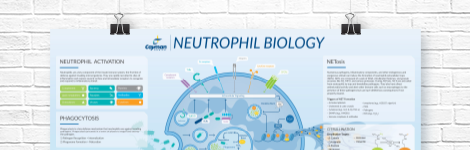
Neutrophil Biology Wall Poster
Explore how neutrophils shape the immune response in health and disease. This poster highlights neutrophil pathogen defense mechanisms, including phagocytosis, degranulation, and NETosis, as well as neutrophil roles in inflammation and NET-associated pathologies.
DOWNLOAD NOWProduct Description
Daclatasvir-d6 is intended for use as an internal standard for the quantification of daclatasvir (Item No. 23730) by GC- or LC-MS. Daclatasvir is a first generation direct-acting inhibitor of hepatitis C virus (HCV) non-structural protein 5A (NS5A; Kds = 8 and 210 nM for the NS5A33-202 and NS5A26-202 residues of HCV genotype 1b, respectively).1,2 It potently inhibits HCV replication in multiple HCV replicon genotypes (EC50s = 9-146 pM) with the highest potency in genotypes 1b and 4a (EC50s = 9 and 12 pM, respectively).1 Daclatasvir disrupts the subcellular localization of NS5A in Huh7.5 cells and inhibits viral RNA synthesis and virion assembly and secretion when used at a concentration of 1 nM in HCV-infected Huh7 cells.3,4 Daclatasvir also inhibits organic anion transport polypeptides 1B1 (OAT1B1) and OAT1B3 (IC50s = 1.5 and 3.27 µM, respectively).5 Formulations containing daclatasvir have been used alone and in combination with NS3/4A and NS5B inhibitors in the treatment of HCV.
WARNING This product is not for human or veterinary use.
References & Product Citations
1. Chemical genetics strategy identifies an HCV NS5A inhibitor with a potent clinical effect. Nature 465(7294), 96-100 (2010).
2. Potent hepatitis C inhibitors bind directly to NS5A and reduce its affinity for RNA. Sci. Rep. 4, 4765 (2014).
3. The hepatitis C virus NS5A inhibitor (BMS-
4. Modeling shows that the NS5A inhibitor daclatasvir has two modes of action and yields a shorter estimate of the hepatitis C virus half-
5. Different interaction profiles of direct-
Contact Info
Cayman Chemical1180 East Ellsworth RoadAnn Arbor, Michigan 48108 USAToll Free: (800) 364-9897(USA and Canada only)Fax: (734) 971-3640


