
Technical Support & Resources
Visit our FAQ
Contact Us
Toll Free Phone (USA and Canada Only): (888) 526-5351
Direct Phone: (734) 975-3888
Product Categories

Technical Information
- N6-Adenosine-methyltransferase METTL16
- EC 2.1.1.346
- EC 2.1.1.62
- Methyltransferase-like Protein 16
- Methyltransferase 10 Domain-containing Protein
- Putative Methyltransferase METT10D
- U6 snRNA Methyltransferase METT10D
- U6 Small Nuclear RNA (adenine-(43)-N(6))-Methyltransferase
Shipping & Storage Information
Recommended Products
Certificates of Analysis & Batch Specific Data
Provide batch numbers separated by commas to download or request available product inserts, QC sheets, certificates of analysis, data packs, and GC-MS data.

Visit Our Cancer Resource Center
Find Tools & Resources to Study the Hallmarks of Cancer
- Cancer cell signaling & regulation
- Cancer metabolism
- Tumor microenvironment
Product Description
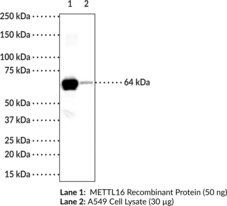
Methyltransferase-like protein 16 (METTL16) is an m6A RNA methyltransferase encoded by the METTL16 gene in humans and localized to the cell nucleus.1,2 It is composed of a methyltransferase domain that associates with RNA and two vertebrate conserved regions (VCRs) on the C-terminal end that promote splicing.3 METTL16 acts as an epigenetic writer by methylating the pre-mRNA of the S-adenosylmethionine (SAM) synthetase MAT2A in the presence of SAM. It also methylates the adenine at position 43 of spliceosome component U6 snRNA and interacts with cancer-associated MALAT1 long non-coding RNA (lncRNA).4,1 Knockout of Mettl16 in mouse embryos leads to a reduction in Mat2a mRNA expression, transcriptome dysregulation, and lethality at approximately the implantation stage.5 The expression of METTL16 is increased in isolated human colon, but not rectal, adenocarcinoma tumor tissue, and decreased METTL16 expression in rectal adenocarcinoma tumor tissue is associated with lower overall survival.6 Cayman’s METTL16 Monoclonal Antibody (Clone 4C9) can be used for ELISA, Immunofluorescence, and Western blot applications. The antibody recognizes METTL16 at 64 kDa from human samples.
WARNING This product is not for human or veterinary use.
References & Product Citations
1. Structural insights into the RNA methyltransferase domain of METTL16. Sci. Rep. 8(1), 5311 (2018).
2. Methyltransferase-
3. The U6 snRNA m6A methyltransferase METTL16 regulates SAM synthetase intron retention. Cell 169(5), 824-835 (2017).
4. Human METTL16 is a N6-
5. Methylation of structured RNA by the m6A writer METTL16 is essential for mouse embryonic development. Mol. Cell. 71(5), 986-1000 (2018).
6. Expression patterns and prognostic value of m6A-
Contact Info
Cayman Chemical1180 East Ellsworth RoadAnn Arbor, Michigan 48108 USAToll Free: (800) 364-9897(USA and Canada only)Fax: (734) 971-3640


