
Technical Support & Resources
Visit our FAQ
Contact Us
Toll Free Phone (USA and Canada Only): (888) 526-5351
Direct Phone: (734) 975-3888
Product Categories
α-Synuclein (Phospho-Ser129) Polyclonal Antibody
Item No. 29252
Technical Information
- SNCA
- α-Syn
Shipping & Storage Information
Recommended Products
Certificates of Analysis & Batch Specific Data
Provide batch numbers separated by commas to download or request available product inserts, QC sheets, certificates of analysis, data packs, and GC-MS data.
Product Description
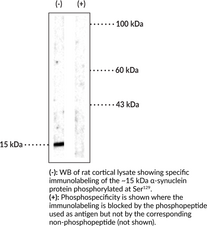
α-Synuclein is a 140-amino acid intracellular protein encoded by the SNCA gene in humans.1 It is primarily localized to the synaptic terminal of neurons in both the central and peripheral nervous systems where it has a role in regulation of synaptic vesicle docking and neurotransmitter release.2 α-Synuclein is an intrinsically disordered, multi-domain protein.1,3 It exists as monomer in the cytoplasm, however, mutations, posttranslational modifications, and changes in cellular environmental conditions can induce oligomerization and aggregate formation that lead to various pathologies, including Parkinson's disease, Lewy body disease, multiple system atrophy (MSA), and amyotrophic lateral sclerosis (ALS). Phosphorylation of α-synuclein at serine 129 (Ser129) is increased in response to mitochondrial stress and is reduced by lysosome inhibition in SH-SY5Y cells.4 It enhances α-synuclein-induced neurotoxicity in Drosophila and rat models of Parkinson's disease.5,4 Levels of phosphorylated Ser129 (phospho-Ser129) are increased in Lewy bodies in postmortem brains from patients with Parkinson's disease and Lewy body disease compared with control individuals.5,6,4 Cayman's α-Synuclein (Phospho-Ser129) Polyclonal Antibody can be used for immunohistochemistry (IHC) and Western blot (WB) applications. The antibody recognizes α-synuclein (phospho-Ser129) at approximately 15 kDa from human, mouse, and rat samples.
WARNING This product is not for human or veterinary use.
References & Product Citations
1. Structure, function and toxicity of alpha-
2. Alpha-
3. The function of α-
4. Mechanisms underlying extensive Ser129-
5. The role of Ser129 phosphorylation of α-
6. Phosphorylation of Ser-
Contact Info
Cayman Chemical1180 East Ellsworth RoadAnn Arbor, Michigan 48108 USAToll Free: (800) 364-9897(USA and Canada only)Fax: (734) 971-3640


