
Technical Support & Resources
Visit our FAQ
Contact Us
Toll Free Phone (USA and Canada Only): (888) 526-5351
Direct Phone: (734) 975-3888
Product Categories
Choline Acetyltransferase Polyclonal Antibody
Item No. 29255
Technical Information
- ChAT
Shipping & Storage Information
Recommended Products
Certificates of Analysis & Batch Specific Data
Provide batch numbers separated by commas to download or request available product inserts, QC sheets, certificates of analysis, data packs, and GC-MS data.
Product Description
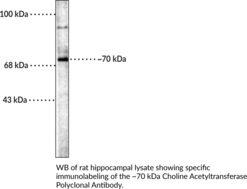
Choline acetyltransferase (ChAT) is an acyltransferase that catalyzes the synthesis of acetylcholine from acetyl coenzyme A (acetyl-CoA; Item No. 16160) and choline.1 It is composed of a catalytic domain flanked on both sides by a substrate binding domain.1,2 ChAT is synthesized in the soma of cholinergic neurons in the central and peripheral nervous system and is transported to nerve terminals where it exists in a soluble form or on synaptic vesicles in a membrane-bound form.1 It is used as a marker of cholinergic neurons.3 Genome-wide deletion of Chat in mice is perinatal lethal.4 Intracerebroventricular transplantation of human HB1.F3 neural stem cells overexpressing CHAT reverses learning and memory deficits in a mouse model of Alzheimer's disease induced by kainic acid (Item No. 78050).5 ChAT activity is reduced in a number of neurodegenerative disorders, including Alzheimer's disease, amyotrophic lateral sclerosis (ALS), and Huntington's disease.1 SNPs in CHAT are associated with Alzheimer's disease in humans.6 Cayman's Choline Acetyltransferase Polyclonal Antibody can be used for immunohistochemistry (IHC) and Western blot (WB) applications. The antibody recognizes ChAT at approximately 70 kDa from human, avian, chicken, guinea pig, mouse, non-human primate, and rat samples.
WARNING This product is not for human or veterinary use.
References & Product Citations
1. Choline acetyltransferase: The structure, distribution and pathologic changes in the central nervous system. Pathol. Int. 49(11), 921-937 (1999).
2. Substrate binding and catalytic mechanism of human choline acetyltransferase. Biochem. 45(49), 14621-14631 (2006).
3. Choline acetyltransferase: Celebrating its fiftieth year. J. Neurochem. 62(5), 1653-1663 (1994).
4. Aberrant patterning of neuromuscular synapses in choline actyltransferase-
5. Human neural stem cells overexpressing choline acetyltransferase restore cognitive function of kainic acid-
6. Association of choline acetyltransferase gene polymorphisms (SNPs rs868750g/A, rs1880676G/A, rs2177369G/A and rs3810950G/A) with Alzheimer’s disease risk: A meta-
Contact Info
Cayman Chemical1180 East Ellsworth RoadAnn Arbor, Michigan 48108 USAToll Free: (800) 364-9897(USA and Canada only)Fax: (734) 971-3640


