
Technical Support & Resources
Visit our FAQ
Contact Us
Toll Free Phone (USA and Canada Only): (888) 526-5351
Direct Phone: (734) 975-3888
Product Categories
Technical Information
- FOX3
- Rbfox3
- RNA Binding Protein Fox-1 Homolog 3
Shipping & Storage Information
Recommended Products
Certificates of Analysis & Batch Specific Data
Provide batch numbers separated by commas to download or request available product inserts, QC sheets, certificates of analysis, data packs, and GC-MS data.
Product Description
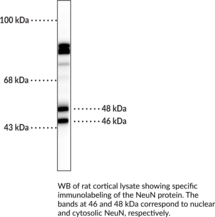
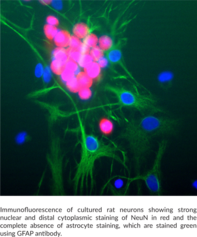
NeuN, also known as FOX3 and RNA binding protein fox-1 homolog 3 (Rbfox3), is a pre-mRNA alternative splicing regulator encoded by RBFOX3 in humans.1,2 It is expressed in mature neurons of the brain and spinal cord and is commonly used as a neuronal marker to quantify the number of new neurons generated during adult neurogenesis or the extent of therapeutic neuroprotection in animal models of neurodegenerative disease.3,4 There are two subtypes of NeuN, a 46 kDa nuclear form and 48 kDa cytoplasmic form. Cytosolic NeuN is increased in the lumbar spinal cord in a mouse model of amyotrophic lateral sclerosis (ALS) compared with control animals.2 Exon deletions and truncations of NeuN are found in patients with Rolandic epilepsy and RBFOX3 is located within the apparently balanced chromosomal rearrangement (ABCR) regions of chromosomes in patients with developmental delays and speech disorders.4 Cayman's NeuN Monoclonal Antibody (Clone 1B7) can be used for immunocytochemistry (ICC), immunohistochemistry (IHC), and Western blot (WB) applications. The antibody recognizes nuclear and cytosolic NeuN at approximately 46 and 48 kDa, respectively.
WARNING This product is not for human or veterinary use.
References & Product Citations
1. Identification of neuronal nuclei (NeuN) as Fox-
2. Cytosolic localization of Fox proteins in motor neurons of G93A SOD1 mice. Histochem. Cell Biol. 145(5), 545-559 (2016).
3. Genetic influence on phenotypic differentiation in adult hippocampal neurogenesis. Brain Res. Dev. Brain Res. 134(1-2), 1-12 (2002).
4. Novel insights into NeuN: From neuronal marker to splicing regulator. Mol. Neurobiol. 53(3), 1637-1647 (2016).
Contact Info
Cayman Chemical1180 East Ellsworth RoadAnn Arbor, Michigan 48108 USAToll Free: (800) 364-9897(USA and Canada only)Fax: (734) 971-3640


