
Technical Support & Resources
Visit our FAQ
Contact Us
Toll Free Phone (USA and Canada Only): (888) 526-5351
Direct Phone: (734) 975-3888
Product Categories
Application
GABAA Receptor β1 Subunit Polyclonal Antibody
Item No. 29273
Technical Information
- GABAA Receptor Subunit β1
- GABRB2
- Gamma-aminobutyric Acid (GABA) A Receptor, β1
- Gamma-aminobutyric Acid Receptor Subunit β1
Shipping & Storage Information
Recommended Products
Certificates of Analysis & Batch Specific Data
Provide batch numbers separated by commas to download or request available product inserts, QC sheets, certificates of analysis, data packs, and GC-MS data.
Product Description
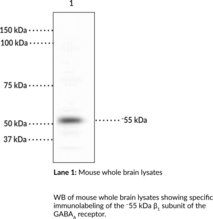
GABAA receptors are ligand-gated chloride channels that mediate the effects of the inhibitory neurotransmitter GABA in the CNS.1,2 They are postsynaptic heteropentameric receptors that contain protein subunits from the following isoforms: α1-6, β1-4, γ1-3, δ, ε, π, θ, and ρ1-3, arranged around a central pore. Phasic inhibitory synaptic transmission is regulated by α1β2γ2 subunit-containing GABAA receptors, the major isoform found in the brain.2,3 The β subunit of GABAA receptors interfaces with an α subunit to form the GABA binding site that initiates GABA-induced action potentials and forms the benzodiazepine binding site with the γ subunit. Phosphorylation of the β1 subunit by PKA or PKC inhibits binding of the β1 subunit with the clathrin adaptor protein AP2 and reduces GABAA receptor endocytosis.4 Mice expressing mutations in Gabrb1, which encodes the β1 subunit isoform, have increased GABAA receptor-mediated tonic inhibition in the nucleus accumbens and increased alcohol consumption compared to wild-type mice.5 SNPs in GABRB1 are associated with increased impulsivity and reward sensitivity in human adolescents.6 Cayman's GABAA Receptor β1 Polyclonal Antibody can be used for Western blot (WB) applications. The antibody recognizes the GABAA receptor β1 subunit at approximately 55 kDa from mouse and rat samples.
WARNING This product is not for human or veterinary use.
References & Product Citations
1. Behavioral functions of GABAA receptor subtypes -
2. Mutant GABAA receptor subunits in genetic (idiopathic) epilepsy. Genetics of epilepsy 55-85 (2014).
3. α subunits in GABAA receptors are dispensable for GABA and diazepam action. Sci. Rep. 7(1), 15498 (2017).
4. The dynamic modulation of GABAA receptor trafficking and its role in the formation of inhibitory synapses. Physiol. Rev. 91(3), 1009-1022 (2011).
5. Mutations in the GABRB1 gene promote alcohol consumption through increased tonic inhibition. Nat. Commun. 4, 2816 (2013).
6. GABRB1 single nucleotide polymorphism associated with altered brain responses (but not performance) during measures of impulsivity and reward senditivity in human adolescents. Front. Behav. Neurosci. 11(24), (2017).
Contact Info
Cayman Chemical1180 East Ellsworth RoadAnn Arbor, Michigan 48108 USAToll Free: (800) 364-9897(USA and Canada only)Fax: (734) 971-3640


