
Technical Support & Resources
Visit our FAQ
Contact Us
Toll Free Phone (USA and Canada Only): (888) 526-5351
Direct Phone: (734) 975-3888
Product Categories
Application
Technical Information
Shipping & Storage Information
Recommended Products
Certificates of Analysis & Batch Specific Data
Provide batch numbers separated by commas to download or request available product inserts, QC sheets, certificates of analysis, data packs, and GC-MS data.
Product Description
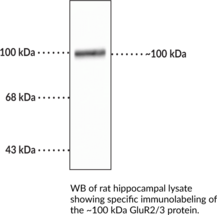
AMPA receptors are ionotropic glutamate receptors that mediate excitatory synaptic transmission.1,2 They are tetrameric protein complexes expressed throughout the central nervous system in both neurons and glia that are assembled from combinations of GluR1, GluR2, GluR3, and GluR4, also known as GluR-A-D, subunits, each of which has extracellular N-terminal and ligand binding domains, a channel domain consisting of three membrane-spanning helices and a channel pore loop, and an intracellular C-terminus.1,3,4,5 GluR1 and GluR2 are predominantly expressed in the forebrain, with low levels of GluR3 and GluR4, and pyramidal neurons express AMPA receptors primarily comprised of heterotetramers of GluR1 and GluR2 subunits. Hippocampal pyramidal neurons also express AMPA receptors composed of GluR2 and GluR3 (GluR2/3) that cycle into and out of synapses constitutively.6 Protein levels of GluR2/3 are decreased in postmortem enterorhinal cortex, frontal cortex, and Purkinje cell samples from patients with sporadic Creutzfeldt-Jakob disease.7 GluR2/3 protein levels are increased on the dendrites of dentate granule cells in postmortem epileptogenic hippocampus samples from patients with temporal lobe epilepsy.8 Cayman's GluR2/3 Polyclonal Antibody can be used for Western blot (WB) applications. The antibody recognizes GluR2/3 at approximately 100 kDa from rat samples.
WARNING This product is not for human or veterinary use.
References & Product Citations
1. The role of the GluR2 subunit in AMPA receptor function and synaptic plasticity. Neuron 54(6), 859-871 (2007).
2. The role of the GluR-
3. The GLUR2 subunit of AMPA receptors: Synaptic role. Neuroscience 158(1), 55-61 (2009).
4. Polymorphisms in the GRIA1 gene region in psychotic bipolar disorder. Am. J. Med. Genet. B Neuropsychiatr. Genet. 150B(1), 24-32 (2009).
5. Role of AMPA receptors in synaptic plasticity. Cell Tissue Res. 326(2), 447-455 (2006).
6. Endocytosis and recycling of AMPA receptors lacking GluR2/3. Proc. Natl. Acad. Sci. USA 105(3), 1038-1043 (2008).
7. GluR2/3, NMDAε1 and GABAA receptors in Creutzfeldt-
8. Glutamate receptor subunits GluR1 and GluR2/3 distribution shows reorganization in the human epileptogenic hippocampus. Eur. J. Neurosci. 10(5), 1687-1703 (1998).
Contact Info
Cayman Chemical1180 East Ellsworth RoadAnn Arbor, Michigan 48108 USAToll Free: (800) 364-9897(USA and Canada only)Fax: (734) 971-3640


