
Technical Support & Resources
Visit our FAQ
Contact Us
Toll Free Phone (USA and Canada Only): (888) 526-5351
Direct Phone: (734) 975-3888
Mitochondrial Fission Factor Polyclonal Antibody
Item No. 29284
Technical Information
- Chromosome Open Reading Frame 33
- MFF
Shipping & Storage Information
Recommended Products
Certificates of Analysis & Batch Specific Data
Provide batch numbers separated by commas to download or request available product inserts, QC sheets, certificates of analysis, data packs, and GC-MS data.

Visit Our Cancer Resource Center
Find Tools & Resources to Study the Hallmarks of Cancer
- Cancer cell signaling & regulation
- Cancer metabolism
- Tumor microenvironment
Product Description
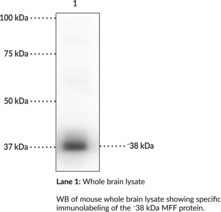
Mitochondrial fission factor (MFF) is a tail-anchored membrane protein with roles in mitochondrial and peroxisomal fission.1,2 It is localized to the outer membrane of mitochondria, as well as the membrane-restricted regions of elongated peroxisomes. It is composed of a cytoplasmic N-terminus that functions as a receptor for the GTPases dynamin-related protein 1 (DRP1) and dynamin-like protein 1 (DLP1), a central coiled-coil domain, and a C-terminal transmembrane domain.3 siRNA knockdown of MFF inhibits DRP1 recruitment and mitochondrial fission induced by loss of mitochondrial membrane potential and delays cytochrome c release from mitochondria and apoptotic progression in vitro.1,3 MicroRNA knockdown of MFF inhibits norepinephrine-induced hypertrophy and mitochondrial fission in isolated neonatal rat ventricular cells.3 MFF is overexpressed in various cancer cells and knockdown of MFF reduces tumor volume in a PC3 mouse xenograft model.4 Cayman's Mitochondrial Fission Factor Polyclonal Antibody can be used for immunohistochemistry (IHC) and Western blot (WB) applications. The antibody recognizes MFF at approximately 38 kDa from human, bovine, and mouse samples.
WARNING This product is not for human or veterinary use.
References & Product Citations
1. The novel tail-
2. Mff functions with Pex11pβ and DLP1 in peroxisomal fission. Biol. Open 2(10), 998-1006 (2013).
3. miR-
4. Mitochondrial fission factor is a novel Myc-
Contact Info
Cayman Chemical1180 East Ellsworth RoadAnn Arbor, Michigan 48108 USAToll Free: (800) 364-9897(USA and Canada only)Fax: (734) 971-3640


