
Technical Support & Resources
Visit our FAQ
Contact Us
Toll Free Phone (USA and Canada Only): (888) 526-5351
Direct Phone: (734) 975-3888
Product Categories
NCC (Phospho-Thr53) Polyclonal Antibody
Item No. 29285
Technical Information
- Sodium Chloride Symporter
Shipping & Storage Information
Recommended Products
Certificates of Analysis & Batch Specific Data
Provide batch numbers separated by commas to download or request available product inserts, QC sheets, certificates of analysis, data packs, and GC-MS data.
Product Description
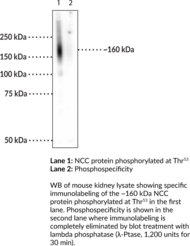
The thiazide-sensitive sodium chloride cotransporter (NCC) is a member of the SLC12 family of transporters and is encoded by SLC12A3 in humans.1 NCC is expressed in epithelial cells of the distal convoluted tubule and localizes to the apical plasma membrane where it mediates sodium reabsorption in the kidney. It consists of a central hydrophobic domain with 12 transmembrane helices that contain affinity-modifying residues for sodium, chloride, and thiazides that is flanked by intracellular N- and C-terminal domains with sites that are subject to phosphorylation. Phosphorylation of NCC at threonine 53 (Thr53) is mediated by serum- and glucocorticoid-inducible kinase 1 (SGK1), STE20/SPS1-related proline-alanine-rich protein kinase (SPAK), or oxidative stress-responsive kinase 1 (OSR1). X. laevis oocytes expressing a threonine-to-alanine substitution at Thr53 in NCC, which abolishes its phosphorylation, have reduced chloride deprivation-induced sodium uptake, but not NCC surface expression, compared to wild-type oocytes.2 NCC (phospho-Thr53) levels are increased in the kidney by low dietary intake of sodium chloride or potassium in mice.3 NCC (phospho-Thr53) levels are also increased in the kidney of the CUL3-Het/∆9 mouse model of familial hyperkalemic hypertension.4 Cayman's NCC (Phospho-Thr53) Polyclonal Antibody can be used for immunofluorescence (IF) and Western blot (WB) applications. The antibody recognizes NCC (phospho-Thr53) at approximately 160 kDa from human, mouse, and rat samples.
WARNING This product is not for human or veterinary use.
References & Product Citations
1. The sodium chloride cotransporter SLC12A3: New roles in sodium, potassium, and blood pressure regulation. Pflugers Arch. 466(1), 107-118 (2014).
2. The Na+:Cl-
3. Expression and phosphorylation of the Na+-
4. Mutant cullin 3 causes familial hyperkalemic hypertension via dominant effects. JCI Insight 2(24), e96700 (2017).
Contact Info
Cayman Chemical1180 East Ellsworth RoadAnn Arbor, Michigan 48108 USAToll Free: (800) 364-9897(USA and Canada only)Fax: (734) 971-3640


