
Technical Support & Resources
Visit our FAQ
Contact Us
Toll Free Phone (USA and Canada Only): (888) 526-5351
Direct Phone: (734) 975-3888
Product Categories
Technical Information
Shipping & Storage Information
Recommended Products
Certificates of Analysis & Batch Specific Data
Provide batch numbers separated by commas to download or request available product inserts, QC sheets, certificates of analysis, data packs, and GC-MS data.
Product Description
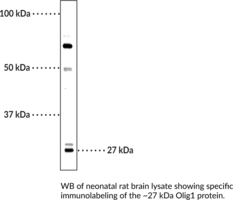
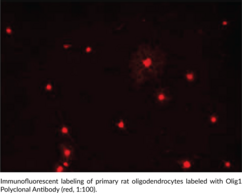
Oligodendrocyte lineage transcription factor 1 (Olig1) is a basic helix-loop-helix transcription factor that promotes the formation and maturation of oligodendrocytes.1 It is expressed in the spinal cord and neuroepithelium of the ventral forebrain, colocalizing with the oligodendrocyte precursor markers Sox10 and Pdgfra. Olig1 is localized to the nucleus at the embryonic stage and is translocated to the cytoplasm after birth.2 However, Olig1 is translocated back to the nucleus of oligodendrocyte precursors following a demyelinating injury. Olig1-/- mice exhibit delayed, but not impaired, spinal cord oligodendrocyte differentiation and maturation, indicating that Olig1 is non-essential to oligodendrocyte differentiation.3 Olig1 knockdown delays mean disease onset and reduces disease severity in a mouse model of myelin oligodendrocyte glycoprotein-induced experimental autoimmune encephalomyelitis.4 Cayman's Olig1 Polyclonal Antibody can be used for immunocytochemistry (ICC), immunohistochemistry (IHC), immunoprecipitation (IP), and Western blot (WB) applications. The antibody recognizes Olig1 at approximately 27 kDa from human, mouse, and rat samples.
WARNING This product is not for human or veterinary use.
References & Product Citations
1. Identification of a novel family of oligodendrocyte lineage-
2. Effect of OLIG1 on the development of oligodendrocytes and myelination in a neonatal rat PVL model induced by hypoxia-
3. New Olig1 null mice confirm a non-
4. Delayed onset of experimental autoimmune encephalomyelitis in Olig1 deficient mice. PLoS One 5(9), e13083 (2010).
Contact Info
Cayman Chemical1180 East Ellsworth RoadAnn Arbor, Michigan 48108 USAToll Free: (800) 364-9897(USA and Canada only)Fax: (734) 971-3640


