
Technical Support & Resources
Visit our FAQ
Contact Us
Toll Free Phone (USA and Canada Only): (888) 526-5351
Direct Phone: (734) 975-3888
Product Categories
Research Area
Application
KCC2 (Phospho-Ser940) Polyclonal Antibody
Item No. 29291
Technical Information
- Electroneutral Potassium Chloride Cotransporter 2
- Neuronal Potassium Chloride Cotransporter
Shipping & Storage Information
Recommended Products
Certificates of Analysis & Batch Specific Data
Provide batch numbers separated by commas to download or request available product inserts, QC sheets, certificates of analysis, data packs, and GC-MS data.
Product Description
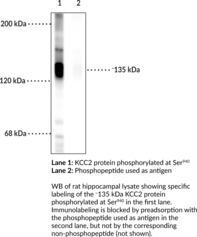
The neuronal-specific potassium chloride cotransporter 2 (KCC2) is a member of the SLC12 family of transporters and is encoded by SLC12A5 in humans.1 KCC2 is expressed in mature neurons throughout the CNS and localizes to the soma and dendrite plasma membrane where it mediates chloride ion efflux, maintaining the transmembrane chloride potential.2 It consists of 12 transmembrane helices, which contain an extracellular loop subject to N-glycosylation, as well as intracellular N- and C-terminal domains with sites that are subject to phosphorylation. Phosphorylation of KCC2 at serine 940 (Ser940) is mediated by PKC and regulates KCC2 stability and expression.1,3 KCC2 (phospho-Ser940) levels are increased by the PKC activator phorbol 12-myristate 13-acetate (PMA; Item No. 10008014) in primary rat embryonic hippocampal neurons.3 HEK293 cells expressing a point mutation of Ser940 (S940A) in KCC2, which abolishes its phosphorylation, have a reduced rate of ion transport and decreased KCC2 endocytosis. Mice expressing S940A have reduced latency to first seizure and increased mortality in a mouse model of status epilepticus induced by kainate.4 Cayman's KCC2 (Phospho-Ser940) Polyclonal Antibody can be used for Western blot (WB) applications. The antibody recognizes KCC2 (Phospho-Ser940) at approximately 135 kDa from mouse and rat samples.
WARNING This product is not for human or veterinary use.
References & Product Citations
1. Reciprocal regulation of KCC2 trafficking and synaptic activity. Front. Cell Neurosci. 13, 48 (2019).
2. Role of the neuronal K-
3. Direct protein kinase C-
4. KCC2 activity is critical in limiting the onset and severity of status epilepticus. PNAS 112(11), 3523-3528 (2015).
Contact Info
Cayman Chemical1180 East Ellsworth RoadAnn Arbor, Michigan 48108 USAToll Free: (800) 364-9897(USA and Canada only)Fax: (734) 971-3640


