
Technical Support & Resources
Visit our FAQ
Contact Us
Toll Free Phone (USA and Canada Only): (888) 526-5351
Direct Phone: (734) 975-3888
Technical Information
- Mitochondrial Transcription Factor 1
- Transcription Factor A, Mitochondrial
Shipping & Storage Information
Recommended Products
Certificates of Analysis & Batch Specific Data
Provide batch numbers separated by commas to download or request available product inserts, QC sheets, certificates of analysis, data packs, and GC-MS data.

Visit Our Cancer Resource Center
Find Tools & Resources to Study the Hallmarks of Cancer
- Cancer cell signaling & regulation
- Cancer metabolism
- Tumor microenvironment
Product Description
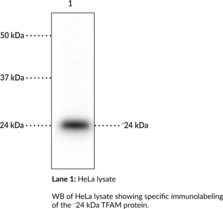
Mitochondrial transcription factor A (TFAM) is a mitochondrial DNA (mtDNA) binding protein that maintains the mitochondrial genome by regulating replication, transcription, and packaging of mtDNA.1 It contains two high mobility group (HMG) box domains that bind mtDNA and induce a conformational change that permits binding of mitochondrial RNA polymerase (mtRNAP) to the promoter start site. TFAM binds to mtRNAP, recruiting mitochondrial transcription factor 2 (TFB2M) and initiating transcription. TFAM also maintains mitochondrial genome stability by non-specifically binding to mtDNA, packaging it into nucleoid-like structures. Homozygous knockout of Tfam in mice is embryonic lethal whereas heterozygous Tfam knockdown mice are viable but have reduced mtDNA copy numbers and decreased activity of the mitochondrial respiratory chain complexes I, III, IV, and V in the heart.2 Genetic overexpression of Tfam reduces age-induced accumulation of lipid peroxidation products in the brain and memory impairments in mice.3 Increased tumor TFAM protein levels are associated with increased tumor size in patients with breast cancer.4 SNPs in TFAM have been identified in patients with a variety of neurodegenerative disorders, including Parkinson's disease, Alzheimer's disease, and Huntington's disease.1 Cayman's TFAM Polyclonal Antibody can be used for Western blot (WB) applications. The antibody recognizes TFAM at approximately 24 kDa from human samples.
WARNING This product is not for human or veterinary use.
References & Product Citations
1. The mitochondrial transcription factor TFAM in neurodegeneration: Emerging evidence and mechanisms. FEBS Lett. 592(5), 793-811 (2018).
2. Mitochondrial transcription factor A is necessary for mtDNA maintance and embryogenesis in mice. Nat. Genet. 18(3), 231-236 (1998).
3. Reverse of age-
4. Increased expression of mitochondrial transcription factor A and nuclear respiratory factor-
Contact Info
Cayman Chemical1180 East Ellsworth RoadAnn Arbor, Michigan 48108 USAToll Free: (800) 364-9897(USA and Canada only)Fax: (734) 971-3640


