Technical Support & Resources
Visit our FAQ
Contact Us
Toll Free Phone (USA and Canada Only): (888) 526-5351
Direct Phone: (734) 975-3888
Product Categories
Technical Information
- TH
- Tyrosine 3-hydroxylase
- Tyrosine 3-monooxygenase
Shipping & Storage Information
Recommended Products
Certificates of Analysis & Batch Specific Data
Provide batch numbers separated by commas to download or request available product inserts, QC sheets, certificates of analysis, data packs, and GC-MS data.
Product Description
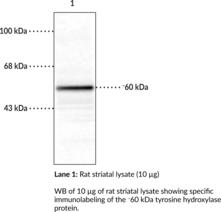
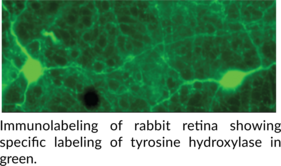
Tyrosine hydroxylase (TH) catalyzes the conversion of tyrosine to L-DOPA, which is the rate-limiting step in the biosynthesis of the catecholamines dopamine, norepinephrine, and epinephrine.1 It assembles into tetramers, with each monomer comprised of an N-terminal regulatory domain with three serine residues at positions 19, 31, and 40 that are subject to regulatory phosphorylation, a central catalytic domain, and a C-terminal tetramerization domain. TH is expressed in dopaminergic neurons in the olfactory bulb, diencephalon, substantia nigra, ventral tegmental area, and retinal amacrine cells, adrenergic and noradrenergic cells in the hypothalamus, medulla, and locus coeruleus (LC), as well as sympathetic ganglia and adrenal chromaffin cells. Due to its expression in catecholaminergic neurons, TH has been used as a marker of these cells in the brain.2 Mutations in TH have been found in patients with tyrosine hydroxylase deficiency, infantile parkinsonism, and progressive infantile encephalopathy.3,4 Cayman's Tyrosine Hydroxylase (rat, native) Polyclonal Antibody can be used for immunocytochemistry (ICC), immunohistochemistry (IHC), and Western blot (WB) applications. The antibody recognizes TH at approximately 60 kDa from human, mouse, rabbit, and rat samples.
WARNING This product is not for human or veterinary use.
References & Product Citations
1. Complex molecular regulation of tyrosine hydroxylase. J. Neural Transm. (Vienna) 121(12), 1451-1481 (2014).
2. A new double labeling technique using tyrosine hydroxylase and dopamine-
3. Tyrosine hydroxylase deficiency: A treatable disorder of brain catecholamine biosynthesis. Brain 133(Pt. 6), 1810-1822 (2010).
4. Moving beyond tyrosine hydroxylase to define dopaminergic neurons for use in cell replacement therapies for Parkinson’s disease. CNS Neurol. Disord. Drug Targets 11(4), 340-349 (2012).
Contact Info
Cayman Chemical1180 East Ellsworth RoadAnn Arbor, Michigan 48108 USAToll Free: (800) 364-9897(USA and Canada only)Fax: (734) 971-3640