
Technical Support & Resources
Visit our FAQ
Contact Us
Toll Free Phone (USA and Canada Only): (888) 526-5351
Direct Phone: (734) 975-3888
Product Categories
METTL3/14 Complex Monoclonal Antibody (Clone 7A9)
Item No. 29313
Technical Information
- N6-Adenosine-Methyltransferase Catalytic Subunit/N6-Adenosine-Methyltransferase Non-catalytic Subunit
- Methyltransferase-like Protein 3/Methyltransferase-like Protein 14
- hMETTL3/hMETTL14
Shipping & Storage Information
Recommended Products
Certificates of Analysis & Batch Specific Data
Provide batch numbers separated by commas to download or request available product inserts, QC sheets, certificates of analysis, data packs, and GC-MS data.

Visit Our Cancer Resource Center
Find Tools & Resources to Study the Hallmarks of Cancer
- Cancer cell signaling & regulation
- Cancer metabolism
- Tumor microenvironment
Product Description
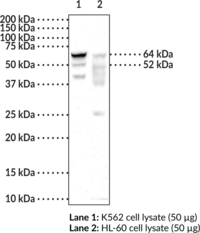
Methyltransferase-like protein 3 (METTL3) and METTL14 are m6A RNA methyltransferases encoded by the METTL3 and METTL14 genes, respectively, in humans.1 METTL3 and METTL14 form a stable complex in the cytoplasm then localize to the nucleus via a METTL3 nuclear localization sequence. METTL3 contains an N-terminal leader helix domain that interacts with Wilms' tumor 1-associated protein (WTAP) in the nucleus, which confers localization of the complex to nuclear speckles. METTL14 contains a C-terminal arginine-glycine-glycine (RGG) sequence that contributes to the catalytic activity of the complex. METTL3 and METTL14 each contain methyltransferase domains but the METTL3 domain alone binds S-adenosylmethionine (SAM) or S-adenosylhomocysteine (SAH) while METTL14 interacts with RNA.2 The METTL3/14 complex primarily binds to regions of RNA that correspond to intergenic and intron regions of DNA, and it preferentially methylates RNA substrates that contain the sequence GGACU, with little preference for secondary structural features of the substrates.3 METTL3 and METTL14 are involved in hematopoietic stem cell differentiation in vitro and are necessary for self-renewal and reconstitution of hematopoietic stem cells following bone marrow transplantation in mice.4 Mettl3 knockdown or Mettl14 knockout increases radial glia cell cycle length in embryonic mouse brain, and Mettl14 knockout extends cortical neurogenesis into the postnatal period.5 Knockdown of METTL3 or METTL14 also increases proliferation of glioblastoma stem cells (GSCs) in vitro and increases tumor size in a mouse orthotopic model using GSCs.6 The expression of METTL3 and METTL14 is reduced in juvenile patients with ETV6/RUNX1(E/R)-positive acute lymphoblastic leukemia (ALL).7 Cayman's METTL3/14 Complex Monoclonal Antibody (Clone 7A9) can be used for ELISA and Western blot (WB) applications. The antibody recognizes METTL3 and METTL14 at approximately 64 and 52 kDa, respectively, from human samples.
WARNING This product is not for human or veterinary use.
References & Product Citations
1. Interactions, localization, and phosphorylation of the m6A generating METTL3-
2. Structural basis for cooperative function of Mettl3 and Mettl14 methyltransferases. Mol. Cell 63(2), 306-317 (2016).
3. A METTL3-
4. Mettl3-
5. Temporal control of mammalian cortical neurogenesis by m6A methylation. Cell 171(4), 877-889 (2017).
6. m6A RNA methylation regulates the self-
7. The study of METTL3 and METTL14 expressions in childhood ETV6/RUNX1-
Contact Info
Cayman Chemical1180 East Ellsworth RoadAnn Arbor, Michigan 48108 USAToll Free: (800) 364-9897(USA and Canada only)Fax: (734) 971-3640


