
Technical Support & Resources
Visit our FAQ
Contact Us
Toll Free Phone (USA and Canada Only): (888) 526-5351
Direct Phone: (734) 975-3888
Product Categories
Research Area
Application
Technical Information
Shipping & Storage Information
Recommended Products
Certificates of Analysis & Batch Specific Data
Provide batch numbers separated by commas to download or request available product inserts, QC sheets, certificates of analysis, data packs, and GC-MS data.
Lipid Resource Center
Discover Products & Resources for Lipid Research
- High-purity lipid standards
- Lipid roles in biology
- Lipids in health & disease
- Lipids for pharmaceutical development
- Protocols, advice, & resources
Product Description
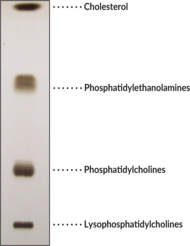
Polar lipids, such as phosphatidylethanolamine and phosphatidylcholine, are amphiphilic cell membrane lipids essential for cellular function, while cholesterol is a membrane lipid important for fluidity, permeability, and membrane organization.1 Phosphatidylethanolamine is the most abundant phospholipid in prokaryotes and the second most abundant found in the membrane of mammalian, plant, and yeast cells, comprising approximately 25% of total mammalian phospholipids.2 Phosphatidylcholine is the most abundant phospholipid in mammalian, plant, and yeast cells.3 It is found mainly in the outer leaflet of cell membranes and can make up approximately half of the total phospholipids.4 In mammalian tissues, phosphatidylcholine commonly contains a saturated and unsaturated fatty acid at the C-1 and C-2 positions of glycerol, respectively. It is a substrate for various enzymes and has a role in cell signaling. Lysophosphatidylcholines are produced by hydrolysis of a fatty acid in phosphatidylcholine.5 They have effects on a variety of cell types, including smooth muscle cells, endothelial cells, T lymphocytes, monocytes, and macrophages among others. Lysophosphatidylcholines are a major phospholipid component of oxidized low-density lipoprotein (ox-LDL), and they accumulate in animal models of atherosclerosis. Cholesterol is a major sterol produced in mammalian cells that is required for cell viability and proliferation.1 It is a component of mammalian cell membranes that interacts with membrane phospholipids, sphingolipids, and proteins to influence their properties. Polar Lipid Mixture (egg, ovine) contains cholesterol and both hydroxy- and non-hydroxy phosphatidylethanolamines, phosphatidylcholines, and lysophosphatidylcholines. It is intended for use as a reference standard for the detection of these polar lipids in various sample types by TLC or LC-MS. This mixture is supplied in an amber ampule in which the headspace has been purged with argon to prevent lipid oxidation. [Matreya, LLC. Catalog No. 1127]
WARNING This product is not for human or veterinary use.
References & Product Citations
1. Cholesterol interactions with phospholipids in membranes. Prog. Lipid Res. 41(1), 66-97 (2002).
2. Formation and function of phosphatidylserine and phosphatidylethanolamine in mammalian cells. Biochim. Biophys. Acta 1831(3), 543-554 (2013).
3. Phosphatidylserine and phosphatidylethanolamine in mammalian cells: Two metabolically related aminophospholipids. J. Lipid Res. 49(7), 1377-1387 (2008).
4. The regulation and cellular functions of phosphatidylcholine hydrolysis. Biochem J. 269(2), 281-291 (1990).
5. Role of lysophosphatidylcholine (LPC) in atherosclerosis. Curr. Med. Chem. 14(30), 3209-3220 (2007).
Contact Info
Cayman Chemical1180 East Ellsworth RoadAnn Arbor, Michigan 48108 USAToll Free: (800) 364-9897(USA and Canada only)Fax: (734) 971-3640


