
Technical Support & Resources
Visit our FAQ
Contact Us
Toll Free Phone (USA and Canada Only): (888) 526-5351
Direct Phone: (734) 975-3888
Product Categories
Application
Technical Information
Shipping & Storage Information
Recommended Products
Certificates of Analysis & Batch Specific Data
Provide batch numbers separated by commas to download or request available product inserts, QC sheets, certificates of analysis, data packs, and GC-MS data.
Lipid Resource Center
Discover Products & Resources for Lipid Research
- High-purity lipid standards
- Lipid roles in biology
- Lipids in health & disease
- Lipids for pharmaceutical development
- Protocols, advice, & resources
Product Description
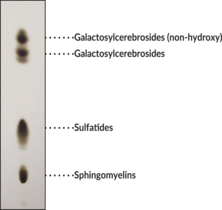
Galactosylceramides are glycosphingolipids that contain galactose attached to a ceramide containing an N-acyl hydroxy or non-hydroxy fatty acid. They are metabolic precursors to sulfatides, found primarily in nerve tissues, and are the main glycosphingolipids in the central nervous system.1,2 Galactosylceramides are involved in a multitude of cellular processes, including cell agglutination, cellular signaling in glycosynapses, cellular development, and activation of T cells.1,2,3 They accumulate in globoid cells in the brain of patients with Krabbe disease, a disorder characterized by a deficiency in galactosylcerebrosidase activity.2 Sulfatides are primarily found in the myelin sheath of oligodendrocytes and Schwann cells, with smaller chain lengths predominant during development and longer chain lengths predominant in mature cells.4 They accumulate in the lysosome of patients with metachromatic leukodystrophy, a disorder characterized by arylsulfatase A deficiency.5,6 Sphingomyelins are bioactive sphingolipids found in mammalian cell membranes.7 They make up 2-15% of the total organ phospholipid population but are found at higher concentrations in the brain and myelin sheaths surrounding peripheral nerves. Sphingolipid Mixture (bovine) contains bovine hydroxy- and non-hydroxy galactosylcerebrosides, sulfatides, and sphingomyelins. It is intended for use as a reference standard for the detection of these sphingolipids in various sample types by TLC or LC-MS. This mixture is supplied in an amber ampule in which the headspace has been purged with argon to prevent lipid oxidation. [Matreya, LLC. Catalog No. 1128]
WARNING This product is not for human or veterinary use.
References & Product Citations
1. Participation of galactosylceramide and sulfatide in glycosynapses between oligodendrocyte or myelin membranes. FEBS Lett. 584(9), 1771-1778 (2010).
2. Krabbe disease: One hundred years from the bedside to the bench to the bedside. J. Neurosci. Res. 94(11), 982-989 (2016).
3. The α and Ω of galactosylceramides in T cell immune function. The Journal of Biological Chemisty 290(25), 15365-15370 (2015).
4. Changes in the fatty acid composition of cerebrosides and sulfatides of human nervous tissue with age. J. Lipid Res. 9(2), 215-225 (1968).
5. Quantification of plasma sulfatides by mass spectrometry: Utility for metachromatic leukodystrophy. Anal. Chim. Acta 955, 79-85 (2017).
6. Role of sulfatide in normal and pathological cells and tissues. J. Lipid Res. 53(8), 1437-1450 (2012).
7. The functional role of sphingomyelin in cell membranes. Eur. J. Lipid Sci. Technol. 109(10), 977-981 (2007).
Contact Info
Cayman Chemical1180 East Ellsworth RoadAnn Arbor, Michigan 48108 USAToll Free: (800) 364-9897(USA and Canada only)Fax: (734) 971-3640


