
Technical Support & Resources
Visit our FAQ
Contact Us
Toll Free Phone (USA and Canada Only): (888) 526-5351
Direct Phone: (734) 975-3888
Product Categories
Product Type
Application
Scavenger Receptor B2/CD36 Blocking Peptide
Item No. 300011
Technical Information
- Fatty Acid Translocase
- GPIIIb
- GPIV
- PAS IV
- Platelet Collagen Receptor
- Platelet Glycoprotein 4
- Thrombospondin Receptor
Shipping & Storage Information
Recommended Products
Certificates of Analysis & Batch Specific Data
Provide batch numbers separated by commas to download or request available product inserts, QC sheets, certificates of analysis, data packs, and GC-MS data.
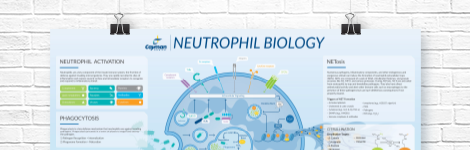
Neutrophil Biology Wall Poster
Explore how neutrophils shape the immune response in health and disease. This poster highlights neutrophil pathogen defense mechanisms, including phagocytosis, degranulation, and NETosis, as well as neutrophil roles in inflammation and NET-associated pathologies.
DOWNLOAD NOWProduct Description
To be used in conjunction with Cayman’s CD36 polyclonal antibody (Item No. 100011) to block protein-antibody complex formation during immunochemical analysis of CD36. CD36 is a type-B scavenger receptor that is necessary for the formation of foam cells in atherosclerotic lesions.1,2,3,4 This membrane glycoprotein can internalize fatty acids which activate PPARγ and stimulate further expression of CD36.5,6 This positive feedback loop combined with the murine CD36 knock-out studies reinforces the importance of CD36 in lipid metabolism. Additionally CD36 is needed for the phagocytosis of P. falciparum infected erythrocytes, retinal pigment epithelial cell photoreceptor fragments, and post-apoptotic monocytes and neutrophils.7,8,9,10 CD36 expression has been monitored during hematopoietic cell differentiation and may be an indicator of tumor spreading in lymphocytic leukemia.11 This transmembrane glycoprotein is detected by immunoblotting at 88 kDa or 54 kDa depending on the degree of glycosylation of the receptor in your sample. Positive controls include adipose and heart tissue, platelets, and macrophages.
WARNING This product is not for human or veterinary use.
References & Product Citations
1. A null mutation in murine CD36 reveals an important role in fatty acid and lipoprotein metabolism. The Journal of Biological Chemisty 274(27), 19055-19062 (1999).
2. Macrophage scavenger receptor CD36 is the major receptor for LDL modified by monocyte-
3. CD36: A class B scavenger receptor involved in angiogenesis, atherosclerosis, inflammation, and lipid metabolism. J. Clin. Invest. 108(6), 785-791 (2001).
4. Native and modified low density lipoproteins increase the functional expression of the macrophage class B scavenger receptor, CD36. The Journal of Biological Chemisty 272(34), 21654-21659 (1997).
5. PPARγ promotes monocyte/macrophage differentiation and uptake of oxidized LDL. Cell 93(2), 241-252 (1998).
6. Membrane glycoprotein CD36: A review of its roles in adherence, signal transduction, and transfusion medicine. Blood 80(5), 1105-1115 (1992).
7. Differential roles of CD36 and αvβ5 integrin in photoreceptor phagocytosis by the retinal pigment epithelium. J. Exp. Med. 194(9), 1289-1298 (2001).
8. Identification of a domain (155-
9. Signals leading to apoptosis-
10. Expression of thrombospondin receptor (CD36) in B-
Contact Info
Cayman Chemical1180 East Ellsworth RoadAnn Arbor, Michigan 48108 USAToll Free: (800) 364-9897(USA and Canada only)Fax: (734) 971-3640


