Technical Support & Resources
Information provided in the product description is from published literature. Due to the nature of scientific experimentation, your results (e.g., selectivity and effective concentrations) or specific application for this product may differ. If you have questions about how this product fits your application, please contact our technical support staff.
Visit our FAQ
Contact Us
Toll Free Phone (USA and Canada Only): (888) 526-5351
Direct Phone: (734) 975-3888
Product Categories
Product Type
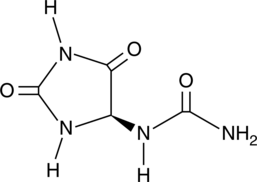
Technical Information
- (±)-Allantoin
- NSC 7606
- SD 101
- 5-Ureidohydantoin
Shipping & Storage Information
Recommended Products
Certificates of Analysis & Batch Specific Data
Provide batch numbers separated by commas to download or request available product inserts, QC sheets, certificates of analysis, data packs, and GC-MS data.
Product Description
Allantoin is a product of purine and uric acid metabolism.1 It is formed through oxidation of uric acid by urate oxidase in most mammals but is formed only through non-enzymatic oxidation by free radicals in humans. Urinary levels of allantoin are increased prior to the onset of Alzheimer’s disease symptoms in mice expressing mutations in amyloid precursor protein and tau (APP/tau) but not during the early/middle stage of the disease, indicating its potential use as a biomarker for predicting Alzheimer’s disease onset.2 Due to the formation of allantoin by free radicals in humans, increased urinary levels are a potential biomarker for oxidative stress status.1
WARNING This product is not for human or veterinary use.
References & Product Citations
1. Allantoin as a marker of oxidative stress: Inter-
2. NMR-
Contact Info
Cayman Chemical1180 East Ellsworth RoadAnn Arbor, Michigan 48108 USAToll Free: (800) 364-9897(USA and Canada only)Fax: (734) 971-3640