
Technical Support & Resources
Visit our FAQ
Contact Us
Toll Free Phone (USA and Canada Only): (888) 526-5351
Direct Phone: (734) 975-3888
BLT1 Receptor (mouse) Monoclonal Antibody (Clone 7A8)
Item No. 30455
Technical Information
- BLTR1
- LTB4 Receptor 1
- Leukotriene B4 Receptor 1
Shipping & Storage Information
Recommended Products
Certificates of Analysis & Batch Specific Data
Provide batch numbers separated by commas to download or request available product inserts, QC sheets, certificates of analysis, data packs, and GC-MS data.
Lipid Resource Center
Discover Products & Resources for Lipid Research
- High-purity lipid standards
- Lipid roles in biology
- Lipids in health & disease
- Lipids for pharmaceutical development
- Protocols, advice, & resources
Product Description
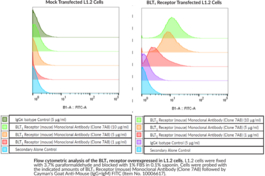
BLT1 is a high-affinity G protein-coupled receptor for leukotriene B4 (LTB4) with roles in the pathogenesis of various inflammatory and immune diseases.1,2 It is expressed in most immune cells, including neutrophils, macrophages, eosinophils, and T cells, as well as certain non-immune cells, such as endothelial cells, fibroblasts, and smooth muscle cells.2 Binding of LTB4 to BLT1 during the onset of inflammation induces early recruitment and activation of neutrophils and inflammatory polarization of macrophages.2,3 BLT1 activation also mediates effector T cell recruitment, providing a link between innate and adaptive immunity during T cell-mediated inflammation. Knockdown of Ltbr41, the gene encoding BLT1, improves glucose tolerance and reduces hyperinsulinemia in a mouse model of high-fat diet-induced obesity.4 Ltbr41 knockdown prevents joint immune cell infiltration and the development of arthritis in multiple mouse models of osteoarthritis and rheumatoid arthritis.5 Loss of Ltbr41 also increases tumor burden and decreases survival in a mouse model of spontaneous colorectal tumor formation.6 Cayman’s BLT1 Receptor (mouse) Monoclonal Antibody (Clone 7AB) can be used for flow cytometry (FC).
WARNING This product is not for human or veterinary use.
References & Product Citations
1. BLT1 and BLT2: The leukotriene B4 receptors. Prostaglandins, Leukot. Essent. Fatty Acids 69(2-3), 123-134 (2003).
2. The role of the LTB4-
3. The leukotriene B4 receptors BLT1 and BLT2 as potential therapeutic targets. Immunol. Rev. 317(1), 30-41 (2023).
4. LTB4 promotes insulin resistance in obese mice by acting on macrophages, hepatocytes and myocytes. Nat. Med. 21(3), 239-247 (2015).
5. LTB4 and BLT1 in inflammatory arthritis. Semin. Immunol. 33, (2017).
6. The yin and yang of leukotriene B4 mediated inflammation in cancer. Semin. Immunol. 33, (2017).
Contact Info
Cayman Chemical1180 East Ellsworth RoadAnn Arbor, Michigan 48108 USAToll Free: (800) 364-9897(USA and Canada only)Fax: (734) 971-3640


