
Technical Support & Resources
Information provided in the product description is from published literature. Due to the nature of scientific experimentation, your results (e.g., selectivity and effective concentrations) or specific application for this product may differ. If you have questions about how this product fits your application, please contact our technical support staff.
Visit our FAQ
Contact Us
Toll Free Phone (USA and Canada Only): (888) 526-5351
Direct Phone: (734) 975-3888
Product Categories

Technical Information
- NC 1264
Shipping & Storage Information
Recommended Products
Certificates of Analysis & Batch Specific Data
Provide batch numbers separated by commas to download or request available product inserts, QC sheets, certificates of analysis, data packs, and GC-MS data.
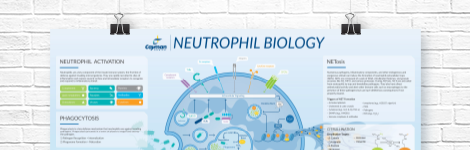
Neutrophil Biology Wall Poster
Explore how neutrophils shape the immune response in health and disease. This poster highlights neutrophil pathogen defense mechanisms, including phagocytosis, degranulation, and NETosis, as well as neutrophil roles in inflammation and NET-associated pathologies.
DOWNLOAD NOWProduct Description
Thonzonium is a quaternary ammonium-containing cationic surfactant with diverse biological activities.1,2,3,4 It is an inhibitor of F. tularensis acid phosphatase B (AcpB; Ki = 0.59 µM) and the vacuolar ATPase (V-ATPase) proton pump in C. albicans (EC50 = 69 µM in purified vacuolar membrane vesicles).1,2 Thonzonium (25-400 nM) inhibits osteoclastogenesis induced by RANKL in bone marrow-derived macrophages (BMDMs) and inhibits bone resorption by mature osteoclasts in a V-ATPase-independent manner when used at concentrations of 100 and 200 nM.3 It prevents bone loss induced by LPS in a calvarial osteolytic mouse model when administered at a dose of 5 mg/kg per day. Thonzonium induces mortality in the helminths C. oncophora, O. ostertagi, H. contortus, and T. circumcincta with EC50 values of 4.5, 10.8, 5.1, and 6.7 µM, respectively, but is cytotoxic to HEK293 and RAW 264.7 cells with CC50 values of 9.2 and 5.7 µM, respectively.4 Formulations containing thonzonium as a surfactant have been used in the treatment of external auditory canal infections, as well as mastoidectomy and fenestration cavity infections.
WARNING This product is not for human or veterinary use.
References & Product Citations
1. Inhibition of AcpA phosphatase activity with ascorbate attenuates Francisella tularensis intramacrophage survival. The Journal of Biological Chemisty 285(8), 5171-5177 (2010).
2. Inhibitors of V-
3. Thonzonium bromide inhibits RANKL-
4. Screening of a drug repurposing library with a nematode motility assay identifies promising anthelmintic hits against Cooperia oncophora and other ruminant parasites. Vet. Parasitol. 265, 15-18 (2019).
Contact Info
Cayman Chemical1180 East Ellsworth RoadAnn Arbor, Michigan 48108 USAToll Free: (800) 364-9897(USA and Canada only)Fax: (734) 971-3640


