An internal standard for the quantification of prostaglandin E2
Related Products
Technical Support & Resources

Visit our FAQ

Contact Us

Toll Free Phone (USA and Canada Only): (888) 526-5351
Direct Phone: (734) 975-3888
Request Technical Support

Technical Support Request

To streamline the process attach the appropriate questionnaire to your inquiry.

Download IHC QuestionnaireDownload WB Questionnaire

View Our Privacy Statement for details on how we use and protect your data. In addition, this site is protected by hCaptcha and its Privacy Policy and Terms of Service apply.

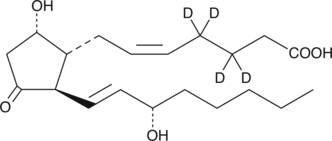
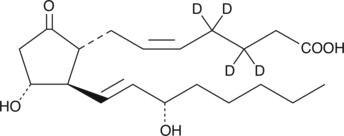
Prostaglandin E2-d4

Item No. 314010

Technical Information
Formal Name
9-oxo-11α,15S-dihydroxy-prosta-5Z,13E-dien-1-oic-3,3,4,4-d4 acid
CAS Number
34210-10-1
Synonyms
  • Dinoprostone-d4
  • PGE2-d4
Molecular Formula
C20H28D4O5
Formula Weight
Purity
≥99% deuterated forms (d1-d4)
Formulation
A 500 µg/ml solution in methyl acetate
DMF: >100 mg/mlDMSO: >100 mg/mlEthanol: >100 mg/mlPBS pH 7.2: >5 mg/ml
SMILES
O[C@H]1[C@H](/C=C/[C@@H](O)CCCCC)[C@@H](C/C=C\C([2H])([2H])C([2H])([2H])CC(O)=O)C(C1)=O
InChi Code
InChI=1S/C20H32O5/c1-2-3-6-9-15(21)12-13-17-16(18(22)14-19(17)23)10-7-4-5-8-11-20(24)25/h4,7,12-13,15-17,19,21,23H,2-3,5-6,8-11,14H2,1H3,(H,24,25)/b7-4-,13-12+/t15-,16+,17+,19+/m0/s1/i5D2,8D2
InChi Key
XEYBRNLFEZDVAW-YOLMOHOWSA-N
Shipping & Storage Information
Storage
-20°C
Shipping
Wet ice in continental US; may vary elsewhere
Recommended Products

Certificates of Analysis & Batch Specific Data

Provide batch numbers separated by commas to download or request available product inserts, QC sheets, certificates of analysis, data packs, and GC-MS data.

    Add

    Add

    Add

    Lipid Resource Center
    Discover Products & Resources for Lipid Research
    • High-purity lipid standards
    • Lipid roles in biology
    • Lipids in health & disease
    • Lipids for pharmaceutical development
    • Protocols, advice, & resources
    EXPLORE NOW
    Product Description

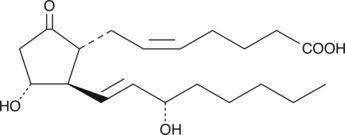
    Prostaglandin E2-d4 (PGE2-d4) contains four deuterium atoms at the 3, 3', 4, and 4' positions. It is intended for use as an internal standard for the quantification of PGE2 by GC- or LC-mass spectrometry. PGE2 is one of the primary cyclooxygenase products of arachidonic acid and one of the most widely investigated prostaglandins. Its activity influences inflammation, fertility and parturition, gastric mucosal integrity, and immune modulation.1,2,3,4 The effects of PGE2 are transduced by at least four distinct receptors designated EP1, EP2, EP3, and EP4.5 The affinity constants (Kd) of PGE2 for these receptors range from 1-10 nM depending on the receptor subtype and tissue.

    WARNING This product is not for human or veterinary use.

    References & Product Citations
    Product Description References

    1. Willis, A.L., and Cornelsen, M. Repeated injection of prostaglandin E2 in rat paws induces chronic swelling and a marked decrease in pain threshold. Prostaglandins 3(3), 353-357 (1973).

    2. Jackson, G.M., Sharp, H.T., and Varner, M.W. Cervical ripening before induction of labor: A randomized trial of prostaglandin E2 gel versus low-dose oxytocin. Am. J. Obstet. Gynecol. 171(4), 1092-1096 (1994).

    3. Robert, A., Schultz, J.R., Nezamis, J.E., et alGastric antisecretory and antiulcer properties of PGE2, 15-methyl PGE2, and 16,16-dimethyl PGE2. Intravenous, oral and intrajejunal administration. Gastroenterology 70(3), 359-370 (1976).

    4. Arvind, P., Papavassiliou, E.D., Tsioulias, G.J., et alProstaglandin E2 down-regulates the expression of HLA-DR antigen in human colon adenocarcinoma cell lines. Biochemistry 34(16), 5604-5609 (1995).

    5. Coleman, R.A., Smith, W.L., and Narumiya, S. International Union of Pharmacology classification of prostanoid receptors: Properties, distribution, and structure of the receptors and their subtypes. Pharmacol. Rev. 46(2), 205-229 (1994).

    Product Citations

    Wu, Z., Xiao, H., Rao, D., et alAnalytical strategy for oxylipin annotation by combining chemical derivatization-based retention index algorithm and feature tandem mass spectrometric fragmentation as a biomarker discovery tool. Anal. Chem. 95(43), 15933-15942 (2023).

    Archambault, A.-S., Brassard, J., Bernatchez, É., et alHuman and mouse eosinophils differ in their ability to biosynthesize eicosanoids, docosanoids, the endocannabinoid 2-arachidonoyl-glycerol and its congeners. Cells 11(1), 141 (2022).

    Roberts, L.M., Schwarz, B., Speranza, E., et alPulmonary infection induces persistent, pathogen-specific lipidomic changes influencing trained immunity. iScience 24(9), 103025 (2021).

    Roulis, M., Kaklamanos, A., Schernthanner, M., et alParacrine orchestration of intestinal tumorigenesis by a mesenchymal niche. Nature 580(7804), 524-529 (2020).

    Archambault, A.-S., Zaid, Y., Rakotoarivelo, V., et alLipid storm within the lungs of severe COVID-19 patients: Extensive levels of cyclooxygenase and lipoxygenase-derived inflammatory metabolites. medRxiv (2020).

    Brouwers, H., Jónasdóttir, H.S., Kuipers, M.E., et alAnti-inflammatory and proresolving effects of the omega-6 polyunsaturated fatty acid adrenic acid. J. Immunol. 205(10), 2840-2849 (2020).

    Meriwether, D., Sulaiman, D., Volpe, C., et alApolipoprotein A-I mimetics mitigate intestinal inflammation in COX2-dependent inflammatory bowel disease model. J. Clin. Invest. 130, 3670-3685 (2019).

    Norris, P.C., Libreros, S., and Serhan, C.N. Resolution metabolomes activated by hypoxic environment. Sci. Adv. 5(10), eaax4895 (2019).

    Maric, J., Ravindran, A., Mazzurana, L., et alCytokine-induced endogenous production of prostaglandin D2 is essential for human group 2 innate lymphoid cell activation. J. Allergy Clin. Immunol. 143(6), 2202-2214 (2019).

    Naoe, S., Tsugawa, H., Takahashi, M., et alCharacterization of lipid profiles after dietary intake of polyunsaturated fatty acids using integrated untargeted and targeted lipidomics. Metabolites 9(10), 241 (2019).

    Dalli, J., Colas, R.A., Walker, M.E., et alLipid Mediator Metabolomics via LC-MS/MS Profiling and Analysis. Clinical Metabolomics 59-72 (2018).

    Sorgi, C.A., Peti, A.P.F., Petta, T., et alComprehensive high-resolution multiple-reaction monitoring mass spectrometry for targeted eicosanoid assays. Sci. Data 5, 180167 (2018).

    Lin, N., Shay, J.E.S., Xie, H., et alMyeloid cell hypoxia-inducible factors promote resolution of inflammation in experimental colitis. Front. Immunol. 9(2565), (2018).

    English, J.T., Norris, P.C., Hodges, R.R., et alIdentification and profiling of specialized pro-resolving mediators in human tears by lipid mediator metabolomics. Prostaglandins Leukot. Essent. Fatty Acids 117, 17-27 (2017).

    Parker, C.G., Galmozzi, A., Wang, Y., et alLigand and target discovery by fragment-based screening in human cells. Cell 168(3), 527-541.e529 (2017).

    Gouveia-Figueira, S., Karlsson, J., Deplano, A., et alCharacterisation of (R)-2-(2-fluorobiphenyl-4-yl)-N-(3-methylpyridin-2-yl)propanamide as a dual fatty acid amide hydrolase: Cyclooxygenase inhibitor. PLoS One 10(9), e0139212 (2015).

    Sasaki, A., Fukuda, H., Shiida, N., et alDetermination of ω-6 and ω-3 PUFA metabolites in human urine samples using UPLC/MS/MS. Anal. Bioanal. Chem. 407(6), 1625-1639 (2015).

    Rouzer, C.A., and Marnett, L.J. Glycerylprostaglandin synthesis by resident peritoneal macrophages in response to a zymosan stimulus. The Journal of Biological Chemisty 280(29), 26690-26700 (2005).

    Sakairi, Y., Jacobson, H.R., Noland, T.D., et al5,6-EET inhibits ion transport in collecting duct by stimulating endogenous prostaglandin synthesis. Am. J. Physiol. 268(5 Pt 2), F931-F939 (1995).