
Technical Support & Resources
Visit our FAQ
Contact Us
Toll Free Phone (USA and Canada Only): (888) 526-5351
Direct Phone: (734) 975-3888
Product Categories
Product Type
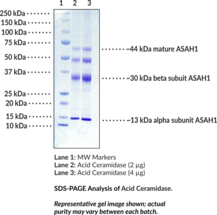
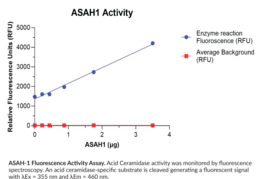
Technical Information
- AC
- ACDase
- N-Acylethanolamine Hydrolase ASAH1
- N-Acylsphingosine Amidohydrolase
- Acylsphingosine Deacylase
- ASAH1
- PHP32
- Putative 32 kDa Heart Protein
Shipping & Storage Information
Recommended Products
Certificates of Analysis & Batch Specific Data
Provide batch numbers separated by commas to download or request available product inserts, QC sheets, certificates of analysis, data packs, and GC-MS data.
Lipid Resource Center
Discover Products & Resources for Lipid Research
- High-purity lipid standards
- Lipid roles in biology
- Lipids in health & disease
- Lipids for pharmaceutical development
- Protocols, advice, & resources
Product Description
Acid ceramidase (AC) is a hydrolase and member of the N-terminal nucleophile superfamily of hydrolases.1,2 It is initially expressed as a proenzyme, which undergoes autocleavage at the peptide bond between threonine 142 and cysteine 143 to produce the active enzyme.3 AC is composed of an α-subunit domain and a β-subunit domain linked by a disulfide bond.1,3 It is ubiquitously expressed and located in the lysosome.3 AC is involved in sphingolipid degradation and hydrolyzes ceramides into sphingolipids and free fatty acids.4 Mutations in ASAH1, the gene encoding AC, are found in patients with Farber disease or spinal muscular atrophy with progressive myoclonic epilepsy (SMA-PME).2,5 Cayman's Acid Ceramidase (human, recombinant) protein can be used for enzyme activity assay, ELISA, and Western blot (WB) applications.
WARNING This product is not for human or veterinary use.
References & Product Citations
1. Structural basis for the activation of acid ceramidase. Nat. Commun. 9(1), 1621 (2018).
2. Substrate-
3. Human acid ceramidase. Processing, glycosylation, and lysosomal targeting. The Journal of Biological Chemisty 276(38), 35352-35360 (2001).
4. Molecular targeting of acid ceramidase: Implications to cancer therapy. Curr. Drug Targets 9(8), 653-661 (2008).
5. Acid ceramidase deficiency: Farber disease and SMA-
Acid ceramidase ASAH1 is a key regulator of epidermal ceramide levels and composition. The Journal of Biological Chemisty 302(3), 111178 (2026).
Contact Info
Cayman Chemical1180 East Ellsworth RoadAnn Arbor, Michigan 48108 USAToll Free: (800) 364-9897(USA and Canada only)Fax: (734) 971-3640


