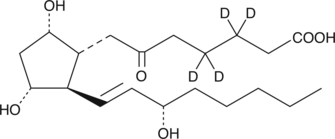
An internal standard for the quantification of 6-keto PGF
Related Products
Technical Support & Resources

Visit our FAQ

Contact Us

Toll Free Phone (USA and Canada Only): (888) 526-5351
Direct Phone: (734) 975-3888

Request Technical Support

Technical Support Request

To streamline the process attach the appropriate questionnaire to your inquiry.

Download IHC QuestionnaireDownload WB Questionnaire

View Our Privacy Statement for details on how we use and protect your data. In addition, this site is protected by hCaptcha and its Privacy Policy and Terms of Service apply.

6-keto Prostaglandin F-d4

Item No. 315210

Technical Information
Formal Name
6-oxo-9α,11α,15S-trihydroxy-prost-13E-en-1-oic-3,3,4,4-d4 acid
CAS Number
82414-64-0
Synonyms
  • 6-keto PGF-d4
Molecular Formula
C20H30D4O6
Formula Weight
Purity
≥99% deuterated forms (d1-d4)
Formulation
A 100 µg/ml solution in methyl acetate
DMF: >100 mg/ml (from 6-keto PGF1a)DMSO: >50 mg/ml (from 6-keto PGF1a)Ethanol: >16 mg/ml (from 6-keto PGF1a)PBS pH 7.2: >3.3 mg/ml (from 6-keto PGF1a
SMILES
O[C@@H]1[C@H](CC(CC([2H])([2H])C([2H])([2H])CC(O)=O)=O)[C@@H](/C=C/[C@H](O)CCCCC)[C@H](O)C1
InChi Code
InChI=1S/C20H34O6/c1-2-3-4-7-14(21)10-11-16-17(19(24)13-18(16)23)12-15(22)8-5-6-9-20(25)26/h10-11,14,16-19,21,23-24H,2-9,12-13H2,1H3,(H,25,26)/b11-10+/t14-,16+,17+,18+,19-/m0/s1/i5D2,6D2
InChi Key
KFGOFTHODYBSGM-GKZGVFJGSA-N
Shipping & Storage Information
Storage
-20°C
Shipping
Room temperature in continental US; may vary elsewhere
Recommended Products

Certificates of Analysis & Batch Specific Data

Provide batch numbers separated by commas to download or request available product inserts, QC sheets, certificates of analysis, data packs, and GC-MS data.

    Add

    Add

    Add

    Add

    Lipid Resource Center
    Discover Products & Resources for Lipid Research
    • High-purity lipid standards
    • Lipid roles in biology
    • Lipids in health & disease
    • Lipids for pharmaceutical development
    • Protocols, advice, & resources
    EXPLORE NOW
    Product Description

    6-keto Prostaglandin F-d4 (6-keto PGF-d4) contains four deuterium atoms at the 3, 3', 4, and 4' positions. It is intended for use as an internal standard for the quantification of 6-keto PGF (Item No. 15210) by GC- or LC-MS. 6-keto PGF is the inactive, non-enzymatic hydrolysis product of PGI2.1,2 6-keto PGF serves as a useful marker of PGI2 biosynthesis in vivo.3 When [3H]-PGI2 is injected into healthy human males, 6.6% of the radioactivity is recovered from urine as [3H]-6-keto PGF.3

    WARNING This product is not for human or veterinary use.

    References & Product Citations
    Product Description References

    1. Pace-Asciak, C.R. Isolation, structure, and biosynthesis of 6-ketoprostaglandin F in the rat stomach. J. Am. Chem. Soc. 98(8), 2348-2349 (1976).

    2. Johnson, R.A., Morton, D.R., Kinner, J.H., et alThe chemical structure of prostaglandin X (prostacyclin). Prostaglandins 12(6), 915-928 (1976).

    3. Brash, A.R., Jackson, E.K., Saggese, C.A., et alMetabolic disposition of prostacyclin in humans. J. Pharmacol. Exp. Ther. 226(1), 78-87 (1983).

    Product Citations

    Maric, J., Ravindran, A., Mazzurana, L., et alCytokine-induced endogenous production of prostaglandin D2 is essential for human group 2 innate lymphoid cell activation. J. Allergy Clin. Immunol. 143(6), 2202-2214 (2019).

    Sorgi, C.A., Peti, A.P.F., Petta, T., et alComprehensive high-resolution multiple-reaction monitoring mass spectrometry for targeted eicosanoid assays. Sci. Data 5, 180167 (2018).

    Lin, N., Shay, J.E.S., Xie, H., et alMyeloid cell hypoxia-inducible factors promote resolution of inflammation in experimental colitis. Front. Immunol. 9(2565), (2018).

    Sasaki, A., Fukuda, H., Shiida, N., et alDetermination of ω-6 and ω-3 PUFA metabolites in human urine samples using UPLC/MS/MS. Anal. Bioanal. Chem. 407(6), 1625-1639 (2015).

    Rouzer, C.A., and Marnett, L.J. Glycerylprostaglandin synthesis by resident peritoneal macrophages in response to a zymosan stimulus. The Journal of Biological Chemisty 280(29), 26690-26700 (2005).