
Technical Support & Resources
Visit our FAQ
Contact Us
Toll Free Phone (USA and Canada Only): (888) 526-5351
Direct Phone: (734) 975-3888
Product Categories
Product Type
SARS-CoV-2 Spike Glycoprotein S2 Subunit (recombinant)
Item No. 31815
Technical Information
- 2019-nCoV Surface Glycoprotein S2 Subunit
- COVID-19 Spike Glycoprotein S2 Subunit
- SARS-CoV-2 Spike Glycoprotein S2 Subunit
- Severe Acute Respiratory Syndrome Coronavirus 2 Spike Glycoprotein S2 Subunit
Shipping & Storage Information
Recommended Products
Certificates of Analysis & Batch Specific Data
Provide batch numbers separated by commas to download or request available product inserts, QC sheets, certificates of analysis, data packs, and GC-MS data.
Neutrophil Biology Wall Poster
Explore how neutrophils shape the immune response in health and disease. This poster highlights neutrophil pathogen defense mechanisms, including phagocytosis, degranulation, and NETosis, as well as neutrophil roles in inflammation and NET-associated pathologies.
DOWNLOAD NOWProduct Description
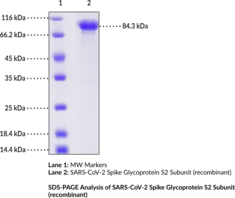
Severe acute respiratory syndrome coronavirus 2 (SARS-CoV-2) is an enveloped positive-stranded RNA virus, a member of the Betacoronavirus genus, and the causative agent of COVID-19.1,2,3,4,5 The SARS-CoV-2 spike glycoprotein, also known as the surface glycoprotein, is a viral structural protein encoded by the S gene in SARS-CoV-2 RNA.1 It is composed of an S1 and S2 subunit divided by a furin S-cleavage site not found in other SARS-CoVs.6,7 The C-terminal S2 subunit, which facilitates fusion between viral and host cell membranes, contains a fusion peptide (FP) and two heptad repeats (HRs), as well as transmembrane and cytoplasmic domains.7,8 Upon insertion of the FP in the target cell membrane, the HRs form a six-helical bundle (6-HB) that enables SARS-CoV-2 to fuse with the target cell. The SARS-CoV-2 spike glycoprotein S2 subunit increases amyloid-β (1-40) (Aβ40) and Aβ42 levels in primary mouse neuron culture supernatants and the number of hippocampal and cortical Aβ plaques in APPswe/PSEN1dE9 transgenic mice.9 Cayman's SARS-CoV-2 Spike Glycoprotein S2 Subunit (recombinant) protein is a disulfide-linked homodimer. The reduced monomer, composed of the SARS-CoV-2 spike glycoprotein S2 subunit (amino acids 686-1,213) fused to mouse IgG1 Fc at its C-terminus, consists of 762 amino acids and has a calculated molecular weight of 84.3 kDa.
WARNING This product is not for human or veterinary use.
References & Product Citations
1. From SARS and MERS CoVs to SARS-
2. Genomic characterisation and epidemiology of 2019 novel coronavirus: Implications for virus origins and receptor binding. Lancet 395(10224), 565-574 (2020).
3. Novel coronavirus 2019-
4. Incidence of thrombotic complications in critically ill ICU patients with COVID-
5. Analysis of 92 deceased patients with COVID-
6. Composition and divergence of coronavirus spike proteins and host ACE2 receptors predict potential intermediate hosts of SARS-
7. Structure, function, and antigenicity of the SARS-
8. Structural and functional properties of SARS-
9. SARS-
Contact Info
Cayman Chemical1180 East Ellsworth RoadAnn Arbor, Michigan 48108 USAToll Free: (800) 364-9897(USA and Canada only)Fax: (734) 971-3640


