
Technical Support & Resources
Visit our FAQ
Contact Us
Toll Free Phone (USA and Canada Only): (888) 526-5351
Direct Phone: (734) 975-3888
Product Categories
Product Type
Technical Information
- GAPD Protein
- G3PD Protein
- HEL-S-162eP
- Peptidyl-cysteine S-nitrosylase
Shipping & Storage Information
Recommended Products
Certificates of Analysis & Batch Specific Data
Provide batch numbers separated by commas to download or request available product inserts, QC sheets, certificates of analysis, data packs, and GC-MS data.

Visit Our Cancer Resource Center
Find Tools & Resources to Study the Hallmarks of Cancer
- Cancer cell signaling & regulation
- Cancer metabolism
- Tumor microenvironment
Product Description
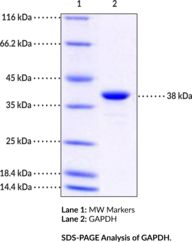
Glyceraldehyde-3-phosphate dehydrogenase (GAPDH) is an enzyme that catalyzes the conversion of glyceraldehyde-3-phosphate (Item No. 17865) to 1,3-bisphosphoglycerate during glycolysis and is involved in numerous additional cellular processes, including intracellular trafficking, receptor-mediated signaling, apoptosis, DNA repair, and the oxidative stress response.1,2 It exists as a tetramer and is composed of an N-terminal domain, which contains binding sites for NAD+, phosphatidylserine, RNA, and glutathione, and a C-terminal catalytic domain.3 GAPDH is widely expressed and primarily localizes to the cytosol, where it has roles in glycolysis and intracellular trafficking.1,4 It also localizes to the nucleus, mediating DNA integrity, gene transcription, and apoptosis, as well as to cellular membranes, where it has roles in membrane fusion and iron transport.4 GAPDH expression is increased by insulin, hypoxia-inducible factor-1 (HIF-1), p53, and nitric oxide (NO) and decreased by acetylated histones.1,5 Aberrant mRNA and protein levels of GAPDH have been found in tumor biopsies from patients with a variety of cancers, including lung, renal cell, colorectal, or breast cancer.6 Cayman's GAPDH (human, recombinant) protein consists of 346 amino acids and has a calculated molecular weight of 38 kDa.
WARNING This product is not for human or veterinary use.
References & Product Citations
1. The diverse functions of GAPDH: Views from different subcellular compartments. Cell. Signal. 23(2), 317-323 (2011).
2. On the functional diversity of glyceraldehyde-
3. Structural analysis of glyceraldehyde-
4. Pleiotropic effects of moonlighting glyceraldehyde-
5. Critical protein GAPDH and its regulatory mechanisms in cancer cells. Cancer Biol. Med. 12(1), 10-22 (2015).
6. Novel insight into the role of GAPDH playing in tumor. Clin. Transl. Oncol. 15(3), 167-172 (2013).
Contact Info
Cayman Chemical1180 East Ellsworth RoadAnn Arbor, Michigan 48108 USAToll Free: (800) 364-9897(USA and Canada only)Fax: (734) 971-3640


