
Technical Support & Resources
Visit our FAQ
Contact Us
Toll Free Phone (USA and Canada Only): (888) 526-5351
Direct Phone: (734) 975-3888
Product Categories
Product Type
Application
B7-1/CD80 Long Isoform Extracellular Domain (human, recombinant; His- and Fc-tagged)
Item No. 31821
Technical Information
- B7.1
- BB1
- CD28LG
- CD28LG1
- LAB7
- T-lymphocyte Activation Antigen CD80
Shipping & Storage Information
Recommended Products
Certificates of Analysis & Batch Specific Data
Provide batch numbers separated by commas to download or request available product inserts, QC sheets, certificates of analysis, data packs, and GC-MS data.

Visit Our Cancer Resource Center
Find Tools & Resources to Study the Hallmarks of Cancer
- Cancer cell signaling & regulation
- Cancer metabolism
- Tumor microenvironment
Product Description
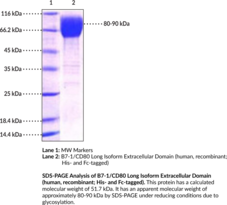
CD80, also known as B7-1, is a glycoprotein and member of the CD28/B7 family of co-stimulatory receptors that promotes T cell activation.1,2 Alternative splicing of CD80 produces one full-length long isoform, CD80 long, and two short isoform, s1CD80 and s2CD80.2 CD80 long exists as a membrane-bound dimer and is composed of an extracellular immunoglobulin variable (IgV) domain that interacts with the co-stimulatory molecule CD28 or the inhibitory molecule CTLA-4, as well as an immunoglobulin constant (IgC) domain and a cytoplasmic tail that are both required for T cell co-stimulation.1 s1CD80 and s2CD80 lack the transmembrane domain or the transmembrane domain and the IgC domain, respectively, and are found in the serum.2 CD80 is transiently expressed on the surface of antigen-presenting cells (APCs) and is upregulated following ligation of the co-stimulatory molecule CD86, as well as by pro-inflammatory stimuli, such as LPS, and downregulated by the anti-inflammatory cytokine IL-10.3,4,5 CD80 has two ligands, CD28 and CTLA-4, that compete for binding and are each expressed on naïve T cells but have opposing functions on T cell activation.6 CD80 binding to CD28 promotes T cell activation, survival, and cytokine production, whereas CD80 binding to CTLA-4 inhibits T cell activation and promotes T cell anergy. Neutralization of CD80 with a monoclonal antibody reduces the severity of synovitis and bone erosion, as well as CD4+ T cell infiltration, in inflamed joints in a mouse model of arthritis induced by complete Freund's adjuvant (CFA) and BSA.7 Decreased CD80 tumor levels have been identified in patients with renal cell carcinoma.8 CD80 SNPs have been found in individuals with gastric cancer.9 Cayman's B7-1/CD80 Long Isoform Extracellular Domain (human, recombinant; His- and FC-tagged) protein can be used for ELISA applications. This protein is a disulfide-linked homodimer. The reduced monomer, comprised of B7-1/CD80 (amino acids 35-242) fused to His-tagged human IgG1 Fc at its C-terminus, consists of 455 amino acids, a calculated molecular weight of 51.7 kDa, and a predicted N-terminus of Val35 after signal peptide cleavage. As a result of glycosylation, the monomer migrates at approximately 80-90 kDa by SDS-PAGE under reducing conditions.
WARNING This product is not for human or veterinary use.
References & Product Citations
1. CD80 and CD86 IgC domains are important for quaternary structure, receptor binding and co-
2. Human soluble CD80 is generated by alternative splicing, and recombinant soluble CD80 binds to CD28 and CD152 influencing T-
3. Costimulation in lymphomas and cancers. Developing costimulatory molecules for immunotherapy of diseases 185-254 (2015).
4. CD80 expression is induced on activated B cells following stimulation by CD86. Scand. J. Immunol. 55(6), 577-584 (2002).
5. IL-
6. CTLA-
7. Distinct in vivo roles of CD80 and CD86 in the effector T-
8. Immunomodulatory molecules in renal cell cancer: CD80 and CD86 are expressed on tumor cells. Int. J. Clin. Exp. Pathol. 10(2), 1443-1454 (2017).
9. A functional variant at miR-
Contact Info
Cayman Chemical1180 East Ellsworth RoadAnn Arbor, Michigan 48108 USAToll Free: (800) 364-9897(USA and Canada only)Fax: (734) 971-3640


