
Technical Support & Resources
Visit our FAQ
Contact Us
Toll Free Phone (USA and Canada Only): (888) 526-5351
Direct Phone: (734) 975-3888
B7-H3/CD276 Extracellular Domain (human, recombinant)
Item No. 31822
Technical Information
- 4Ig-B7-H3
- B7 Homolog 3
- B7RP-2
Shipping & Storage Information
Recommended Products
Certificates of Analysis & Batch Specific Data
Provide batch numbers separated by commas to download or request available product inserts, QC sheets, certificates of analysis, data packs, and GC-MS data.

Visit Our Cancer Resource Center
Find Tools & Resources to Study the Hallmarks of Cancer
- Cancer cell signaling & regulation
- Cancer metabolism
- Tumor microenvironment
Product Description
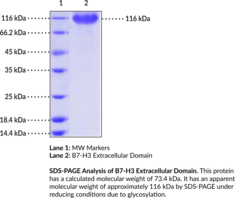
B7-H3, also known as CD276, is a type I transmembrane glycoprotein and member of the B7-CD28 immune checkpoint protein family with roles in the T cell-mediated immune response.1,2 It is encoded by CD276 in humans and is composed of an N-terminal signal peptide, an extracellular domain containing two identical pairs of immunoglobulin (Ig) constant (IgC) and variable (IgV) domains, a transmembrane region, and an intracellular tail. CD276 is ubiquitously expressed, however, protein expression is post-transcriptionally regulated.2 B7-H3 protein is constitutively expressed on non-immune fibroblasts, endothelial cells, and osteoblasts, and can be induced in immune cells such as dendritic cells, macrophages, natural killer (NK) cells, and T cells. It inhibits NK cell-mediated lysis, as well as induces co-inhibition of T cells, increases activation of tumor-specific cytotoxic T cells, and decreases proliferation of CD4+ and CD8+ T cells through modulation of nuclear factor of activated T cells (NFAT), NF-κB, and AP-1. Serum levels of B7-H3 are increased in patients with sepsis, as are intestinal levels in patients with graft versus host disease. High tumor levels of B7-H3 protein are associated with increased tumor size, poorly differentiated tumors, lymph invasion, and shorter overall survival in patients with lung and breast cancers.3 Cayman's B7-H3/CD276 Extracellular Domain (human, recombinant) protein is a disulfide-linked homodimer. The reduced monomer, comprised of B7-H3 (amino acids 1-461) fused to human IgG1 Fc at its C-terminus, consists of 673 amino acids, has a calculated molecular weight of 73.4 kDa, and a predicted N-terminus of Gly27 after signal peptide cleavage. As a result of glycosylation, the monomer migrates at approximately 116 kDa by SDS-PAGE under reducing conditions.
WARNING This product is not for human or veterinary use.
References & Product Citations
1. B7-
2. The third group of the B7-
3. B7-
Contact Info
Cayman Chemical1180 East Ellsworth RoadAnn Arbor, Michigan 48108 USAToll Free: (800) 364-9897(USA and Canada only)Fax: (734) 971-3640


