
Technical Support & Resources
Visit our FAQ
Contact Us
Toll Free Phone (USA and Canada Only): (888) 526-5351
Direct Phone: (734) 975-3888
Product Categories
Product Type
Technical Information
- B7 Homolog 4
- B7h.5
- B7S1
- B7x
- Immune Costimulatory Protein B7-H4
- PRO1291
- V-set Domain-containing T cell Activation Inhibitor 1
- VCTN1
Shipping & Storage Information
Recommended Products
Certificates of Analysis & Batch Specific Data
Provide batch numbers separated by commas to download or request available product inserts, QC sheets, certificates of analysis, data packs, and GC-MS data.

Visit Our Cancer Resource Center
Find Tools & Resources to Study the Hallmarks of Cancer
- Cancer cell signaling & regulation
- Cancer metabolism
- Tumor microenvironment
Product Description
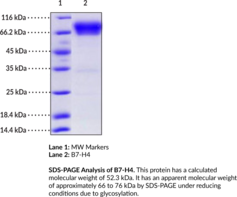
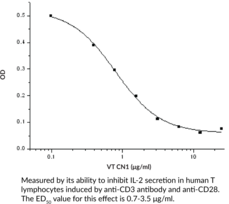
B7-H4 is a glycoprotein linked to the cell membrane via glycosylphosphatidylinositol (GPI) and a member of the B7-CD28 immune checkpoint protein family.1 It is composed of an extracellular domain containing immunoglobulin (Ig) variable (IgV) and Ig constant (IgC) domains with several cysteine residues and N-glycosylation sites.2,1 B7-H4 is found on T cells, B cells, natural killer (NK) cells, dendritic cells, monocytes, and tumor cells, and B7-H4 mRNA is expressed in non-lymphoid tissues such as the lungs, testis, and pancreas.1,3,4 The expression of B7-H4 is induced by inflammatory mediators and cytokines, and it acts as a co-stimulatory molecule to promote regulatory T cell development and inhibit T cell activation, cell cycle progression, proliferation, and cytokine production.1,3 VTCN1 is overexpressed in a variety of cancers, including breast and ovarian cancers, and the levels of expression correlate with lymph node metastasis, cancer progression, and mortality.4,5 siRNA knockdown of VTCN1, the gene encoding B7-H4, decreases proliferation and migration of pancreatic cancer cells in vitro.5 Knockout of VTCN1 in mice reduces lung metastasis and increases survival in a metastatic breast cancer mouse xenograft model. Cayman’s B7-H4 (human, recombinant) protein can be used for cell-based assay applications. This protein is a disulfide-linked homodimer. The reduced monomer, comprised of B7-H4 (amino acids 29-258) fused to human IgG1 Fc at its C-terminus, consists of 471 amino acids and has a calculated molecular weight of 52.3 kDa. As a result of glycosylation, the monomer migrates at approximately 66 to 76 kDa by SDS-PAGE under reducing conditions.
WARNING This product is not for human or veterinary use.
References & Product Citations
1. The B7 family of immune-
2. The third group of the B7-
3. B7x: A widely expressed B7 family member that inhibits T cell activation. Proc. Natl. Acad. Sci. USA 100(18), 10388-10392 (2003).
4. A review of B7-
5. Could B7-
Contact Info
Cayman Chemical1180 East Ellsworth RoadAnn Arbor, Michigan 48108 USAToll Free: (800) 364-9897(USA and Canada only)Fax: (734) 971-3640


