
Technical Support & Resources
Visit our FAQ
Contact Us
Toll Free Phone (USA and Canada Only): (888) 526-5351
Direct Phone: (734) 975-3888
Product Categories
Product Type
Application
Technical Information
- CDw32
- Fc-γ RII-b
- FcγRIIB
- FcRII-b
- IgG Fc Receptor II-b
- Low Affinity Immunoglobulin Gamma Fc Region Receptor II-b
Shipping & Storage Information
Recommended Products
Certificates of Analysis & Batch Specific Data
Provide batch numbers separated by commas to download or request available product inserts, QC sheets, certificates of analysis, data packs, and GC-MS data.
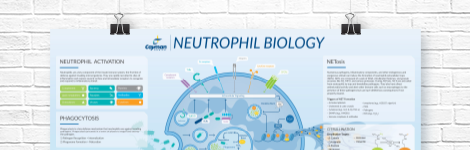
Neutrophil Biology Wall Poster
Explore how neutrophils shape the immune response in health and disease. This poster highlights neutrophil pathogen defense mechanisms, including phagocytosis, degranulation, and NETosis, as well as neutrophil roles in inflammation and NET-associated pathologies.
DOWNLOAD NOWProduct Description
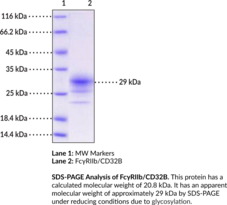
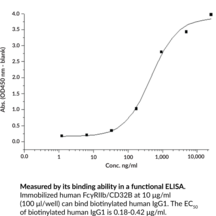
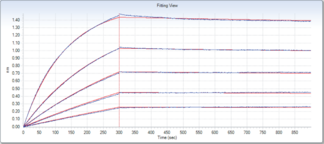
FcγRIIb, also known as CD32B, is a low-affinity IgG receptor that binds the Fc region of IgG.1,2 It is composed of two immunoglobulin-like (Ig-like) extracellular domains, a transmembrane domain, and a cytoplasmic tail domain containing an immunoreceptor tyrosine-based inhibitory motif (ITIM), which is important for its signaling activity.2 The FcγRIIb isoform is generated via alternative splicing and has a shorter cytoplasmic tail than the FcγRIIa isoform, which allows the FcγRIIb isoform to be endocytosed. FcγRIIb is predominantly expressed on myeloid-derived cells, whereas the FcγRIIa isoform is primarily expressed on B cells. FcγRIIb is a co-inhibitory receptor that, when phosphorylated at the ITIM region, inhibits the activation of activating FcγRs on myeloid cells and of B cell receptors but can also inhibit B cell receptor activation in the absence of ITIM phosphorylation. It inhibits the pathogen clearing activity mediated by activating FcγRs, including reducing phagocytosis and cytokine release by myeloid cells, and reduces immune complex-mediated cellular activation, such as inhibiting B cell activation or inducing apoptosis of self-reactive B cells.1 A SNP in FCGR2B, the gene encoding FcγRIIb, is associated with susceptibility to systemic lupus erythematosus (SLE), and SNPs in FCGR2B are also associated with rheumatoid arthritis and immune thrombocytopenic purpura (ITP).3 Cayman's FcγRIIb/CD32B (human, recombinant) protein can be used for binding assay applications. This protein consists of 183 amino acids and has a calculated molecular weight of 20.8 kDa. By SDS-PAGE, under reducing conditions, the apparent molecular mass of the protein is approximately 29 kDa due to glycosylation.
WARNING This product is not for human or veterinary use.
References & Product Citations
1. FcγRIIB and autoimmunity. Immunol. Rev. 269(1), 194-211 (2016).
2. New revelations from an old receptor: Immunoregulatory functions of the inhibitory Fc gamma receptor, FcγRIIB (CD32B). J. Leukoc. Biol. 103(6), 1077-1088 (2018).
3. Comprehensive assessment of the association between FCGRs polymorphisms and the risk of systemic lupus erythematosus: Evidence from a meta-
Contact Info
Cayman Chemical1180 East Ellsworth RoadAnn Arbor, Michigan 48108 USAToll Free: (800) 364-9897(USA and Canada only)Fax: (734) 971-3640


