
Technical Support & Resources
Visit our FAQ
Contact Us
Toll Free Phone (USA and Canada Only): (888) 526-5351
Direct Phone: (734) 975-3888
Product Categories
Product Type
Application
CD4 Extracellular Domain (human, recombinant)
Item No. 31831
Technical Information
- Cluster of Differentiation 4
- T Cell Surface Antigen T4
- T Cell Surface Glycoprotein CD4
Shipping & Storage Information
Recommended Products
Certificates of Analysis & Batch Specific Data
Provide batch numbers separated by commas to download or request available product inserts, QC sheets, certificates of analysis, data packs, and GC-MS data.

Visit Our Cancer Resource Center
Find Tools & Resources to Study the Hallmarks of Cancer
- Cancer cell signaling & regulation
- Cancer metabolism
- Tumor microenvironment
Product Description
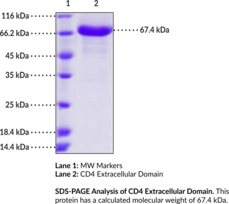
CD4 is a type I transmembrane glycoprotein that functions as a T cell receptor (TCR) co-receptor.1 It exists as a single polypeptide chain composed of four extracellular immunoglobulin-like (Ig-like) domains that interact with MHC class II molecules, a transmembrane domain, and a cytoplasmic tail that associates with the tyrosine kinase LCK and mediates signal transduction to the TCR, which is essential for T cell activation.2 It is expressed on the surface of, and used as a marker for, T cells, and its expression is used to characterize the development stage of thymocytes. Upon binding to antigen-displaying MHC class II molecules expressed by antigen-presenting cells (APCs), naïve CD4+ T cells differentiate and proliferate in a cytokine-dependent manner into a variety of T helper (Th) cell subsets, including Th1, Th2, and Th17 cells, which enhance and direct innate and adaptive immune cell responses to numerous pathogens and have additional roles in cancer, asthma and allergy, and autoimmunity.3,4 CD4 is also the receptor for HIV attachment and entry into cells, resulting in depletion of CD4+ cells in patients infected with HIV.5,6 Cayman's CD4 Extracellular Domain (human, recombinant) protein can be used for cell-based assay applications. This protein is a disulfide-linked homodimer. The reduced monomer, comprised of CD4 (amino acids 26-390) fused to human IgG1 Fc at its C-terminus, consists of 603 amino acids, has a calculated molecular weight of 67.4 kDa, and a predicted N-terminus of Lys26 after signal peptide cleavage.
WARNING This product is not for human or veterinary use.
References & Product Citations
1. Structural characterization of the transmembrane and cytoplasmic domains of human CD4. Biochim. Biophys. Acta 1768(12), 2949-2960 (2007).
2. The T cell receptor: Structure of its proteins and genes. The immune response: Basic and clinical principles 311-340 (2006).
3. Origins of CD4+ circulating and tissue-
4. CD4 T cells: Fates, functions, and faults. Blood 112(5), 1557-1569 (2008).
5. HIV: Cell binding and entry. Cold Spring Harb. Perspect. Med. 2(8), a006866 (2012).
6. Pathophysiology of CD4+ T-
Contact Info
Cayman Chemical1180 East Ellsworth RoadAnn Arbor, Michigan 48108 USAToll Free: (800) 364-9897(USA and Canada only)Fax: (734) 971-3640


