
Technical Support & Resources
Visit our FAQ
Contact Us
Toll Free Phone (USA and Canada Only): (888) 526-5351
Direct Phone: (734) 975-3888
Product Categories
Product Type
Application
Technical Information
- BCM1
- BLAST
- Blast-1
- MEM-102
- SLAMF2
Shipping & Storage Information
Recommended Products
Certificates of Analysis & Batch Specific Data
Provide batch numbers separated by commas to download or request available product inserts, QC sheets, certificates of analysis, data packs, and GC-MS data.
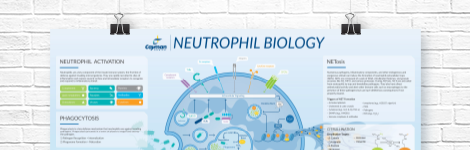
Neutrophil Biology Wall Poster
Explore how neutrophils shape the immune response in health and disease. This poster highlights neutrophil pathogen defense mechanisms, including phagocytosis, degranulation, and NETosis, as well as neutrophil roles in inflammation and NET-associated pathologies.
DOWNLOAD NOWProduct Description
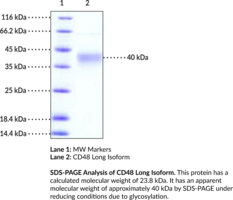
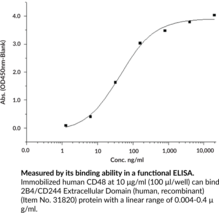
CD48 is a glycoprotein and member of the signaling lymphocyte activation marker (SLAM) family that has diverse roles in innate and adaptive immunity.1 Alternative splicing of CD48 pre-mRNA produces one full-length isoform, CD48 long, and a short isoform, in humans.1 CD48 long is comprised of an extracellular N-terminal immunoglobulin (Ig) variable-like (IgV) domain that mediates heterophilic interactions, an Ig constant 2-like 2 (IgC2) domain, and a glycosylphosphatidylinositol (GPI) anchor that localizes CD48 to the cell membrane and facilitates intracellular signaling.1,2 It is constitutively expressed on most human hematopoietic cells, including monocytes, neutrophils, and lymphocytes, and is localized to lipid rafts.1 CD48 is upregulated by inflammatory conditions, including cytokine stimulation, as well as bacterial or viral infection.1 It binds the co-stimulatory molecule CD2 on T cells and natural killer (NK) cells to promote immune synapse formation and T cell receptor signaling, as well as the bacterial lectin FimH, to enhance pathogen clearance. CD48 also binds CD244 on NK cells and certain subsets of T cells, regulating the activation and cytolytic function of these cells. CD48 levels are increased on plasma cells isolated from patients with multiple myeloma, and neutralization of CD48 with a monoclonal antibody reduces tumor growth in an OPM-2 mouse xenograft model.3 It is also increased on blood eosinophils in patients with atopic asthma.1 Cayman's CD48 Long Isoform (human, recombinant) protein can be used for binding assay applications. This protein consists of 205 amino acids, has a calculated molecular weight of 23.8 kDa, and a predicted N-terminus of Gln27 after signal peptide cleavage. By SDS-PAGE, under reducing conditions, the apparent molecular mass of the protein is approximately 40 kDa due to glycosylation.
WARNING This product is not for human or veterinary use.
References & Product Citations
1. Roles of CD48 in regulating immunity and tolerance. Clin. Immunol. 164, 10-20 (2016).
2. Sequence, structure, function, immunity: Structural genomics of costimulation. Immunol. Rev. 229(1), 356-386 (2009).
3. CD48 as a novel molecular target for antibody therapy in multiple myeloma. Br. J. Haematol. 156(2), 213-224 (2012).
Contact Info
Cayman Chemical1180 East Ellsworth RoadAnn Arbor, Michigan 48108 USAToll Free: (800) 364-9897(USA and Canada only)Fax: (734) 971-3640


