
Technical Support & Resources
Visit our FAQ
Contact Us
Toll Free Phone (USA and Canada Only): (888) 526-5351
Direct Phone: (734) 975-3888
Product Categories
Product Type
Technical Information
- Carcinoembryonic Antigen CGM6
- Carcinoembryonic Antigen-related Cell Adhesion Molecule 8
- CGM6
- NCA-95
- Non-specific Cross-reacting Antigen NCA-95
Shipping & Storage Information
Recommended Products
Certificates of Analysis & Batch Specific Data
Provide batch numbers separated by commas to download or request available product inserts, QC sheets, certificates of analysis, data packs, and GC-MS data.

Visit Our Cancer Resource Center
Find Tools & Resources to Study the Hallmarks of Cancer
- Cancer cell signaling & regulation
- Cancer metabolism
- Tumor microenvironment
Product Description
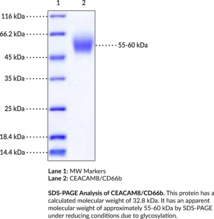
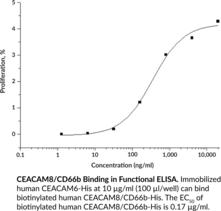
CD66b, also known as carcinoembryonic antigen-related cell adhesion molecule 8 (CEACAM8), is a member of the carcinoembryonic antigen (CEA) family encoded by CEACAM8 in humans.1,2 It is a single-chain glycoprotein, comprised of N-terminal immunoglobulin (Ig) variable-like (IgV) and Ig constant-like (IgC) domains, that is anchored to the cell membrane by a glycosylphosphatidylinositol (GPI) linker.3 CD66b is expressed exclusively in granulocytes, with neutrophil and eosinophil expression increasing under inflammatory conditions to mediate intercellular adhesion to endothelial cells, signal transduction, and cell activation.1,3 The percentage of colonic CD66b+ neutrophils is increased and positively correlates with endoscopic disease severity in patients with Crohn’s disease.4 The percentage of CD66b+ neutrophils is also increased in gastric cancer tissues and is associated with poor prognosis.5 Cayman’s CEACAM8/CD66b (human, recombinant) protein can be used for binding assays. The protein consists of 296 amino acids, has a calculated molecular weight of 32.8 kDa, and a predicted N-terminus of Gln35 after signal peptide cleavage. By SDS-PAGE, under reducing conditions, the apparent molecular mass of the protein is approximately 55 to 60 kDa due to glycosylation.
WARNING This product is not for human or veterinary use.
References & Product Citations
1. CD66b regulates adhesion and activation of human eosinophils. J. Immunol. 179(12), 8454-8462 (2007).
2. CD66a, CD66b, CD66c, and CD66d each independently stimulate neutrophils. J. Leukoc. Biol. 60(1), 106-117 (1996).
3. Interdependency of CEACAM-
4. Recruitment of activated neutrophils correlates with disease severity in adult Crohn’s disease. Clin. Exp. Immunol. 195(2), 251-264 (2019).
5. Prognostic significance of the infiltration of CD163+ macrophages combined with CD66b+ neutrophils in gastric cancer. Cancer Med. 7(5), 1731-1741 (2018).
Contact Info
Cayman Chemical1180 East Ellsworth RoadAnn Arbor, Michigan 48108 USAToll Free: (800) 364-9897(USA and Canada only)Fax: (734) 971-3640


