
Technical Support & Resources
Visit our FAQ
Contact Us
Toll Free Phone (USA and Canada Only): (888) 526-5351
Direct Phone: (734) 975-3888
Product Categories
Product Type
Application
Technical Information
- ARMD11
- CYS3
- Cystatin 3
Shipping & Storage Information
Recommended Products
Certificates of Analysis & Batch Specific Data
Provide batch numbers separated by commas to download or request available product inserts, QC sheets, certificates of analysis, data packs, and GC-MS data.
Product Description
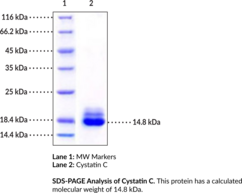
Cystatin C, also known as cystatin 3, is a member of the cystatin superfamily of cysteine protease inhibitors encoded by CST3 in humans.1 It is a 120-amino acid peptide constitutively produced by all nucleated cells and, following signal peptide cleavage, is secreted in all tissues and body fluids.1,2,3 Cystatin C is an inhibitor of endogenous cysteine proteases, including cathepsins B, H, and L, as well as lysosomal proteinases, that regulates extracellular matrix (ECM) production and degradation.1 Due to the small size and basic pI of cystatin C, it is not freely filtered by the glomerulus and is reabsorbed by, and catabolized in, tubular epithelial cells, which facilitates its use as a biomarker of glomerular filtration rate (GFR). Serum and urine levels of cystatin C are increased in pediatric acute kidney injury patients.3 Cayman's Cystatin C (human, recombinant) protein can be used for enzyme activity assay applications. This protein consists of 131 amino acids and has a calculated molecular weight of 14.8 kDa.
WARNING This product is not for human or veterinary use.
References & Product Citations
1. Cystatin C. Ann. Clin. Biochem. 39(2), 89-104 (2002).
2. Cystatin C-
3. Accuracy of cystatin C in prediction of acute kidney injury in children; serum or urine levels: which one works better? A systematic review and meta-
Contact Info
Cayman Chemical1180 East Ellsworth RoadAnn Arbor, Michigan 48108 USAToll Free: (800) 364-9897(USA and Canada only)Fax: (734) 971-3640


