
Technical Support & Resources
Visit our FAQ
Contact Us
Toll Free Phone (USA and Canada Only): (888) 526-5351
Direct Phone: (734) 975-3888
Product Categories
Research Area
Technical Information
- ADABP
- ADCP2
- Adenosine Deaminase Complexing Protein 2
- Dipeptidyl Peptidase 4
- DPP-IV
- T-cell Activation Antigen CD26
- TP103
Shipping & Storage Information
Recommended Products
Certificates of Analysis & Batch Specific Data
Provide batch numbers separated by commas to download or request available product inserts, QC sheets, certificates of analysis, data packs, and GC-MS data.

Explore Obesity & Metabolic Disease Resources
Discover high-quality research tools to investigate GLP-1 mechanisms and next-generation metabolic targets.
OBESITY RESEARCH SOLUTIONSProduct Description
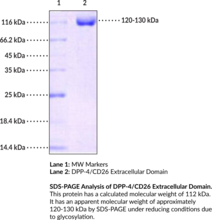
Dipeptidyl peptidase 4 (DPP-4), also known as CD26, is a type II transmembrane glycoprotein with a major role in glucose metabolism.1 It is composed of a short cytoplasmic tail, a transmembrane domain, and a large extracellular domain, which contains a flexible stalk, glycosylation- and cysteine-rich regions, and a catalytic region. DPP-4 is expressed in endothelial and epithelial tissues, as well as T cells, activated B cells, activated natural killer (NK) cells, and myeloid cells. It functions as a homodimer that cleaves X-proline dipeptides from the N-terminus of various polypeptide substrates, such as GLP-1, to regulate glucose metabolism, immune responses, nociception, and blood pressure.1,2,3 Additionally, DPP-4 acts as a co-stimulator of T cell receptor-mediated T cell activation and functional receptor for Middle East respiratory syndrome coronavirus (MERS-CoV).1,4 Small molecule-induced inhibition of DPP-4 improves glucose tolerance in animal models of insulin resistance and has antihypertensive effects in various rodent models of hypertension.2,3 Cayman's DPP-4/CD26 Extracellular Domain (human, recombinant) protein can be used for binding assays. This protein is a disulfide-linked homodimer. The reduced monomer, composed of DPP-4 (amino acids 29-766) fused to His-tagged human IgG1 Fc at its N-terminus, consists of 975 amino acids and has a calculated molecular weight of 112 kDa. As a result of glycosylation, the monomer migrates at approximately 120-130 kDa by SDS-PAGE under reducing conditions.
WARNING This product is not for human or veterinary use.
References & Product Citations
1. Cut to the chase: A review of CD26/dipeptidyl peptidase-
2. DPP-
3. DPP-
4. The potential effects of DPP-
Contact Info
Cayman Chemical1180 East Ellsworth RoadAnn Arbor, Michigan 48108 USAToll Free: (800) 364-9897(USA and Canada only)Fax: (734) 971-3640


