
Technical Support & Resources
Visit our FAQ
Contact Us
Toll Free Phone (USA and Canada Only): (888) 526-5351
Direct Phone: (734) 975-3888
Product Categories
Product Type
Research Area
Application
Technical Information
- IFNγR1
- Immune Interferon Receptor 1
- Interferon Gamma Receptor Alpha-chain
Shipping & Storage Information
Recommended Products
Certificates of Analysis & Batch Specific Data
Provide batch numbers separated by commas to download or request available product inserts, QC sheets, certificates of analysis, data packs, and GC-MS data.

Visit Our Cancer Resource Center
Find Tools & Resources to Study the Hallmarks of Cancer
- Cancer cell signaling & regulation
- Cancer metabolism
- Tumor microenvironment
Product Description
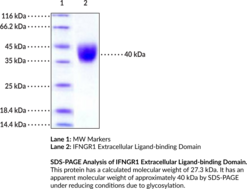
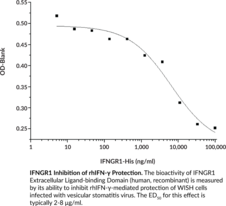
The interferon-γ (IFN-γ) receptor is a heterodimeric receptor with roles in innate and adaptive immunity, as well as a wide range of infectious and inflammatory diseases.1,2 It is composed of two IFNGR1 chains that bind IFN-γ and two non-ligand binding IFNGR2 chains that facilitate signal transduction. IFNGR1 is a transmembrane protein that is composed of an extracellular IFN-γ binding domain and an intracellular domain that contains binding motifs for JAK1 and the transcription factor STAT1, and an isoleucine-leucine sequence at residues 270 and 271 that is required for receptor internalization.2 Upon INF-γ binding, IFNGR1 is phosphorylated by JAK1 to induce STAT1 recruitment to the receptor, which is then translocated to the nucleus to initiate gene transcription.2,3 Ifngr1-/- mice exhibit increased susceptibility to bacterial, parasitic, and viral infections, such as Theiler's murine encephalomyelitis, L. major, L. monocytogenes, and various mycobacteria.2,4 IFNGR1 SNPs have been associated with both increased and decreased susceptibility to pulmonary tuberculosis infection in humans.1 IFNGR1 SNPs have also been associated with increased susceptibility to H. pylori infection and increased risk of developing chronic gastritis and gastric carcinomas.5 Cayman's IFNGR1 Extracellular Ligand-binding Domain (human, recombinant) can be used for Western blot and cell-based assays. This protein consists of 239 amino acids after removal of the signal peptide and has a calculated molecular weight of 27.3 kDa. By SDS-PAGE, under reducing conditions, the apparent molecular mass of Cayman's IFNGR1 Extracellular Ligand-binding Domain (human, recombinant) is 40 kDa due to glycosylation.
WARNING This product is not for human or veterinary use.
References & Product Citations
1. Association of genetic polymorphisms of IFNGR1 with the risk of pulmonary tuberculosis in Zahedan, Southeast Iran. Tuberc. Res. Treat. 292505 (2015).
2. Interferon-
3. IFN-
4. Identifying the initiating events of anti-
5. The interferon gamma receptor 1 (IFNGR1) –56C/T gene polymorphism is associated with increased risk of early gastric carcinoma. Gut 57(11), 1504-1508 (2008).
Contact Info
Cayman Chemical1180 East Ellsworth RoadAnn Arbor, Michigan 48108 USAToll Free: (800) 364-9897(USA and Canada only)Fax: (734) 971-3640


