
Technical Support & Resources
Visit our FAQ
Contact Us
Toll Free Phone (USA and Canada Only): (888) 526-5351
Direct Phone: (734) 975-3888
Product Categories
Product Type
Application
Galectin 9 Short Variant (human, recombinant)
Item No. 32012
Technical Information
- Gal-9S
- HUAT
- Human Urate Transporter
- Lectin Galactoside-binding Soluble 9
- LGALS9A
Shipping & Storage Information
Recommended Products
Certificates of Analysis & Batch Specific Data
Provide batch numbers separated by commas to download or request available product inserts, QC sheets, certificates of analysis, data packs, and GC-MS data.

Visit Our Cancer Resource Center
Find Tools & Resources to Study the Hallmarks of Cancer
- Cancer cell signaling & regulation
- Cancer metabolism
- Tumor microenvironment
Product Description
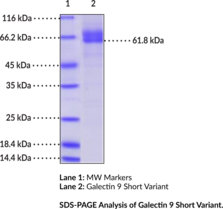
Galectin 9 is a β-galactoside-binding protein encoded by the LGALS9 gene and a member of the galectin family.1 It contains two non-identical carbohydrate recognition domains (CRDs) joined by a peptide linker, the length of which depends on alternative splicing of the LGALS9 gene, which produces a short, medium, or long variant of the protein.1,2 The non-identical CRDs are responsible for binding to different types of saccharide ligands with the N-terminal CRD (NCRD) preferring more complex glycoconjugates.1 Galectin 9 is localized to the cytosol, nucleus, and extracellular matrix and is expressed primarily in immune-related tissues and cells.3 When expressed on immune or tumor cells, galectin 9 binds to glycosylated sites on the immunoregulatory protein TIM-3 and activates signaling that impairs immune synapse formation leading to T cell anergy or apoptosis.4 It also binds to the transmembrane glycoprotein CD44 on osteoblasts, leading to their proliferation, and it has a role in cell adhesion by preventing hyaluronic acid from binding to CD44.5 The short variant of galectin 9 acts as an eosinophil chemoattractant.6 It also activates CD4+ T cell populations and induces naïve T cells to acquire a central memory T cell (TCM) phenotype.7 Galectin 9 was originally identified as a tumor antigen in patients with Hodgkin’s disease.1 It is expressed to a lower extent in tumor cells compared with non-tumor cells but is increased in leukemia and colon cancer cell lines.3 Increased expression of the short variant of galectin 9 inhibits or enhances adhesion in breast or colon cancer cell lines, respectively. The expression of the short variant of galectin 9 is increased by interferon γ (IFN-γ) in synovial fibroblasts isolated from patients with rheumatoid arthritis.8 Cayman's Galectin 9 Short Variant (human, recombinant) protein is a disulfide-linked homodimer. The reduced monomer, comprised of galectin 9 (amino acids 2-323) fused to human IgG1 Fc at its N-terminus, consists of 554 amino acids and has a calculated molecular weight of 61.8 kDa.
WARNING This product is not for human or veterinary use.
References & Product Citations
1. Crystal structure of the galectin-
2. Regulation of galectin-
3. Galectin-
4. TIM3 comes of age as an inhibitory receptor. Nat. Rev. Immunol. 20(3), 173-185 (2020).
5. Galectin-
6. Functional analysis of the carbohydrate recognition domains and a linker peptide of galectin-
7. Galectin-
8. Endogenous galectin-
Contact Info
Cayman Chemical1180 East Ellsworth RoadAnn Arbor, Michigan 48108 USAToll Free: (800) 364-9897(USA and Canada only)Fax: (734) 971-3640


