
Technical Support & Resources
Visit our FAQ
Contact Us
Toll Free Phone (USA and Canada Only): (888) 526-5351
Direct Phone: (734) 975-3888
Product Categories
Product Type
CD1b Long Isoform Extracellular Ligand-binding Domain (human, recombinant)
Item No. 32015
Technical Information
- R1
Shipping & Storage Information
Recommended Products
Certificates of Analysis & Batch Specific Data
Provide batch numbers separated by commas to download or request available product inserts, QC sheets, certificates of analysis, data packs, and GC-MS data.
Lipid Resource Center
Discover Products & Resources for Lipid Research
- High-purity lipid standards
- Lipid roles in biology
- Lipids in health & disease
- Lipids for pharmaceutical development
- Protocols, advice, & resources
Product Description
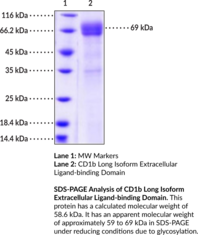
CD1b is a member of the CD1 family of transmembrane glycoproteins and is an MHC class I-like molecule that presents lipid antigens to T cells.1 Alternative splicing of CD1B produces one full-length isoform, CD1b long, and one short isoform.2 CD1b long exists as a tetramer where each monomer is composed of a transmembrane CD1 heavy chain that contains three extracellular domains (α1-α3), which associate with β2-microglobulin to form a lipid-binding groove, as well as a cytoplasmic tail that contains a YXXZ endosomal sorting motif and interacts with the chaperone proteins AP-2 and AP-3 to direct CD1b intracellular trafficking.1,2,3,4 The CD1b short isoform lacks the endosomal sorting motif and is confined to the cell surface.2 CD1b expression is induced in antigen-presenting cells by bacteria or toll-like receptor 2 (TLR2), IL-1β, or GM-CSF stimulation and functions to present a variety of lipid antigens to T cells.5 CD1b is synthesized in the endoplasmic reticulum and is transported to the cell membrane where it expresses self-lipids, such as sphingolipids and phospholipids.5,6 It is then internalized and localizes to the late endosome or lysosome where it exchanges self-lipids for pathogen-derived lipids, including mycolates and lipoglycans, prior to being re-expressed on the cell surface for T cell presentation. CD1b protein levels are increased in skin lesions from patients with leprosy, in lung granulomas from patients with tuberculosis, and in postmortem-derived brain lesions from patients with multiple sclerosis.5,7 CD1B SNPs have been found in patients with prostate cancer.8 Cayman's CD1b Long Isoform Extracellular Ligand-binding Domain (human, recombinant) protein is a disulfide-linked homodimer. The reduced monomer, comprised of CD1b Long Isoform Extracellular Ligand-binding Domain (amino acids 18-303) fused to human IgG1 Fc at its C-terminus, consists of 527 amino acids, has a calculated molecular weight of 58.6 kDa, and a predicted N-terminus of Ser18. As a result of glycosylation, the monomer migrates at approximately 59 to 69 kDa by SDS-PAGE under reducing conditions.
WARNING This product is not for human or veterinary use.
References & Product Citations
1. Anatomy of CD1-
2. Conservation of CD1 intracellular trafficking patterns between mammalian species. J. Immunol. 169(12), 6951-6958 (2002).
3. Intracellular trafficking pathway of newly synthesized CD1b molecules. EMBO J. 21(4), 825-834 (2002).
4. CD1: From molecules to diseases. F1000Res. 6, 1909 (2017).
5. The intricacies of self-
6. An alternative path for antigen presentation: Group 1 CD1 proteins. J. Immunol. 184(7), 3303-3305 (2010).
7. CD1b-
8. Prognostic value of CD1B in localised prostate cancer. Int. J. Environ. Res. Public Health 16(23), 4723 (2019).
Contact Info
Cayman Chemical1180 East Ellsworth RoadAnn Arbor, Michigan 48108 USAToll Free: (800) 364-9897(USA and Canada only)Fax: (734) 971-3640


